My First Real Endorsement

After posting the fake endorsements last week, I'm pumped to have my first actual endorsement of Live Prayerfully. Wil Hernandez is several things for me: a spiritual director, friend, teacher, and all-around encourager. One of the reasons I enjoy every conversation with Wil so much is that he really knows his stuff, and he's tied together a passion for learning, for teaching, and for helping others grow. Among the things he does are to direct Spring Arbor University's Master of Arts in Spiritual Formation and Leadership and helping others continue to benefit from the wisdom of Henri Nouwen through the Nouwen Legacy. Wil was the first person I asked for an endorsement, and the first one to send one to me. It's an honor. (Plus, I really like what he says- any connection made between a cookie jar and prayer is a winner in my book.)

"Prayerful living entails both intentionality and spontaneity. Daniel Harris's work shows what such a combination looks like in concrete fashion! Here's a no-frills piece that brings the cookie jar of prayer into the lower shelf---accessible, relatable, and doable. Harris's memorable three-point outline captures succinctly the essence of how to live prayerfully while his corresponding guides demonstrate well its practical outworking. Definitely a helpful tool for beginners and practitioners alike!" Wil Hernandez, PhD, spiritual director, retreat leader, and author of a trilogy on Henri Nouwen

[Fake] Endorsements for My Book

I'm putting in a lot of time on the manuscript of Live Prayerfully in an effort to try to meet my deadline. While doing so today and working on some formatting issues, I thought it would be helpful to designate a front/back of a page where I hope people's endorsements of it will be printed. The only problem is that so far I have no such endorsements, as I'm not quite ready to start asking for them. But, since I needed some filler for those pages, I entertained myself by making up my own endorsements for the book and attributing them to whomever I wanted. Just incase any search engine ever comes across the names on this page, let me be clear that none of the people here ever said anything like this.

And the fake endorsements for my book:

“This is, unquestionably, the best book I have ever read.” St. Paul, author, half of the New Testament of The Holy Bible

Daniel Harris is cool cool cool cool cool cool cool cool cool cool cool cool cool cool cool cool cool cool cool cool cool cool cool cool cool cool cool cool cool cool cool cool cool cool cool cool cool cool cool cool cool cool cool cool cool cool cool cool cool cool cool cool cool cool cool cool cool cool cool cool cool cool cool cool cool cool cool cool cool cool cool cool cool cool cool cool cool cool cool cool cool cool cool cool cool cool cool cool cool cool cool cool cool cool cool cool cool cool.” Dallas Willard, author, The Divine Conspiracy

“Wow, and I thought I was smart. After reading this, I really don’t know what to do with myself.” M. Robert Mulholland Jr., professor emeritus, Asbury Theological Seminary

“ABCDEFGHIJKLMNOPQRSTUVWXYandZ. ABCDEFGHIJKLMNOPQRSTUVWXYandZ. ABCDEFGHIJKLMNOPQRSTUVWXYandZ. ABCDEFGHIJKLMNOPQRSTUVWXYandZ. ABCDEFGHIJKLMNOPQRSTUVWXYandZ.” Robert Pelfrey, dean, School of Everything Cool

“You know, I am continually amazed at how smart I am. I mean, I really dazzle myself.” Daniel Harris, author, this book

“Wow, and I thought Bob Mulholland and I were smart. After reading this, I really don’t know what we're going to do with ourselves.” N.T. Wright, the leading Bible scholar in the entire world

“I really really really really really really really really really really really really really really really really really really really really really really really really really really really really really really really really really really really really really really really really really really really really really really really really really really really really really really really really really really really really really really really really really really really really really really really really really really really really really really really really really really really really really really really really really really really really really really really really really really really really really really really really really really really really really really really really really really really really really really really really really really really really really really like this guy.” Kara Harris, wife of the author

“Dang. I wish I’d written this.” John Wesley, founder of Methodism

“How many more of these should I come up with? I mean, it’s fun to do this, but I’m starting to feel a bit convicted. Dear God, may no lawyer ever come across this page.” Daniel Harris, author, this book

“Blah blah blah Blah blah blah Blah blah blah Blah blah blah Blah blah blah Blah blah blah Blah blah blah Blah blah blah Blah blah blah Blah blah blah Blah blah blah Blah blah blah Blah blah blah Blah blah blah Blah blah blah Blah blah blah Blah blah blah Blah blah blah Blah blah blah Blah blah blah Blah blah blah Blah blah blah Blah blah blah Blah blah blah Blah blah blah.” Jorge H. Lopez, pastor, MegaFrater

“Every year, millions of books are published. Honestly, for 2012, this is one of them.” General Spokesperson for The General Public

And The Cover Is...

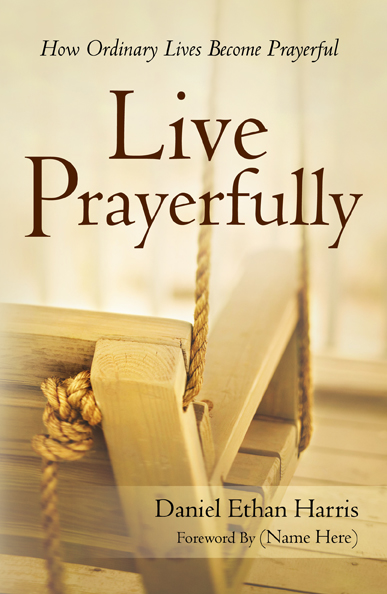
Live Prayerfully eBook Cover I enjoyed working with a bunch of talented folks at CrowdSpring over the past couple of weeks to get a cover design done. After 145 submissions from 23 different creatives, I chose the design pictured above by Roy Migabon (CrowdSpring Creative ID: LioArtimis).

There hasn't been much happening here on the blog, but that's because I'm working toward my self-imposed deadline for this book! (I still don't like deadlines- but's it's kept things moving.)

Help Me Pick a Book Cover

  CS

I'm hosting a contest on CrowdSpring to try and find a cover for Live Prayerfully. The contest still has a few days left, but some good stuff has already come in, so I thought I'd go ahead and start getting some feedback from some of you.

I've selected 8 of the best entries. If you can take a few minutes, rate each of them with 1-5 stars and leave any comments if you want, I'd greatly appreciate it.

To get started, just click here.

Thanks!

Live Prayerfully Conclusion

[I'm working on finishing up drafts for the chapters to Live Prayerfully: Three Ways Ordinary Lives Become Prayerful. The general of the aim of the book is to provide guidance on historic practices of prayer in simple ways. Below is a draft of the Conclusion. I'd love your feedback, so please consider leaving a comment. And if you like it, share it on Facebook or Twitter.]

The Making of Prayerful People

Synergy: the interaction or cooperation of two or more organizations, substances, or other agents to produce a combined effect greater than the sum of their separate effects.

I find I am better or worse as I pray more or less. Prayer tones up the whole of life. I can never be better in life than I am faithful in prayer. If prayer lags, life sags. If we know how to pray, we know how to live; if not, then we exist, we don’t live. When I pray, I’m like an electric bulb in the socket, full of life and power. When I don’t pray, then I’m like that bulb out of the socket- lifeless.

E. Stanley Jones


The secret to a life of prayer, by and large, is showing up.

Robert Benson


My first sincere attempts as a youth at growing toward a prayerful life were by praying with my own words. Other than when we said the Lord’s Prayer in worship services, this was the only way of prayer that I knew, so it was the only way that I prayed for years.

In my first years after college, I enjoyed the discovery of reading spiritual writers who taught about praying without words. For a time, that became my primary way of praying, though by then praying with my own words was deeply ingrained enough in me that I could not completely let go of it.

About a decade later, while I sat at a Transforming Community retreat and listened to Ruth Haley Barton teach on fixed-hour prayer, I felt my soul being drawn like a magnet to the kind of prayer she described. I had experienced it in the Transforming Community and other places without even realizing what it was we were doing, so then as Ruth taught us this centuries-old way of praying with other people’s words, I was eager to explore it and shape my life around it.

Upon returning home from that retreat, I immediately bought a copy of The Divine Hours and began a rhythm of praying with other people’s words through fixed-hour prayer. I immediately noticed how it became a valuable bridge for me. Being a new parent, I often had days when the craziness of adapting to life with a baby in the house meant that my normal space for praying without words and/or praying with my own words was pushed aside. Yet with the constant rhythm of fixed-hour prayer, I was able to bridge those gaps.

As I became more familiar with the rhythm of praying with other people’s words through fixed-hour prayer, I began to experiment with incorporating times of praying without words and praying with my own words into those established times of prayer. Then I experienced synergy.

Having benefited from each of these three ways of praying, initially each independently of the others, I was surprised to notice the difference it made when I put them together. I felt like every part of me was becoming more open to God, like I was finally getting a taste of the kind of prayerful life I had always wanted.

I can’t say for sure whether or not your experience will the same. In some ways, it certainly will not. But I can say that since I have found God’s grace to be available so abundantly through these three ways of praying passed down to us from countless numbers of followers of Jesus throughout history, I am reasonably certain that you will too.

One more thing: I said in the Introduction that a prayerful life is meant for everyone. Here in the Conclusion I want to add to that statement and say: a prayerful life is meant for everyone, and none of us become prayerful by ourselves. Perhaps the synergy that surpasses that of putting together practices of praying with other people’s words, praying without words, and praying with your own words is that of putting these practices together with others. It might be on a retreat, in a small group, or with your family, but the only way we are meant to live prayerfully is to live prayerfully together.

Part II of this book is a guide that you and others can use to do so.

How I Grew Up Loving the Church, Even Though I Didn't Really Like Church

[This is one of the posts telling a story from the life of my Dad. Click here to see the others.]

As I mentioned in the tribute that I wrote for my Dad's funeral service, one of the things for which I am most grateful about the way that he and my Mom raised us is how they passed their commitment to church on to my brothers and me. I've written quite a bit about how they've influenced my faith, but in this post I'm trying to address something that's certainly related but also not quite the same: the commitment to those communities of people in which we learn to live in Christ, to love one another, and through which we represent Christ to the world (our churches).

As the tribute mentions, I don't recall either of my parents ever laying down a verbal rule about church, but it was undeniably ingrained in us that if it was a Sunday morning, we were always going to be in church. Even on the last Sunday of his life, when later that night he went into inpatient hospice care, my Dad was in church. A week after his last Sunday in church, when all of our family had gathered after his death on Thursday, many people were surprised to see us in church together. If they were surprised, it was because they didn't know my Dad well. We were simply doing what he had always done: it was Sunday morning, and we were in church together as a family.

As grateful as I am for this, something about it has puzzled me for a long time: I know that I'm not the only person in the world who grew up going to church every Sunday, so how is it that I came out of my childhood loving the church while many others who went often like I did grow up to become nominally committed to a church at best, or even wanting nothing to do with any church at worst?

I have two very early church memories with my Dad that begin to shed light on what may be the answer. He volunteered in various ways in the church we belonged to when I was very young. I was young enough not to have any idea what the role was that he was playing, but I remember two ways that he often let me tag along and play a role myself. One of those was that at the end of the worship service, he would carry me, holding me up high enough to where I could blow out the candles at the front of the sanctuary (obviously I had to have been pretty young). For me, blown out candles are one of those examples of how a smell can carry tremendously strong memories attached to it, so that about 30 years later it's hard for me not to have a flashback whenever there's a candle blown out, particularly in a church.

The second memory is of being with my Dad in the church office on Sunday mornings while everyone else was in their Sunday School classes. Again, I don't remember what kind of work he did in there, but what I do remember was that in that office there was a small button on the wall. Dad watched the clock and would let me know when the moment had come to push the button, and it would ring a bell throughout the classrooms indicating the Sunday School hour was over and that it was time to go to the sanctuary for the worship service.

I looked back on that memory while I was working for a couple of years in charge of a large Sunday School program, and something interesting about that memory occurred to me for the first time: I wasn't in Sunday School. That realization didn't surprise me. I have vague memories of really disliking Sunday School as a child, so the irony wasn't lost on me that a boy who disliked Sunday School grew up to be in charge of it.

Yet even though I disliked Sunday School so much as a kid (and I really have no recollection as to why that was the case), I never remember disliking the church. In fact, as far as I can remember, I've always liked it. I think the reason why is that even though it took a while for me to really like church (the things that we did on Sundays), I have always loved and been loved by the church (as in the people with whom we did those things).

From as far back as I can remember as a child, there were people who made going to church fun for me. And the really interesting thing as I reflect on it is that all the people who come to mind when I think of those who did this for me were adults. I liked my friends like every young person does, but they weren't the difference maker for me. Obviously I liked spending time in the office with my Dad and being held up by him to blow out the candles. I've also written here about a hero of mine named Chester (see The Man Who Never Had a Bad Day) who made church fun for my brothers and me. Then there were others when I was a bit older, and later it was youth ministers... always adults, and the difference they made for me always happened in small ways apart from the plans of the normal church programs. They knew my name, liked it when I sat next to them in a worship service, and offered me candy or a high five. Those things meant the world to me as a kid, even though I didn't realize it at the time.

I love the church we are a part of now that I have my own family. It's the first time in my life I've been part of a larger church, which certainly comes along with its advantages, as this church is able to do a lot of things that we'd never been able to do in previous churches. But one of the drawbacks can be that since we have so many good programs, it's a temptation for us to think that kids will grow up to love the church as long as we have them in those good programs. But what it really comes down to is adults who love God going out of their way to help the young ones grow up knowing that they matter. Any adult in a church can do this, and every Mom and Dad in a church must do it. So with my little ones growing up in church now, it has me wondering two things: Am I giving my kids the chance to develop those kinds of relationships with adults in our church? And am I playing that role for the young ones in our church (both my own kids and others)?

I don't know why my parents decided to let me spend the Sunday School hour in the church office with my Dad rather than making me go to a Sunday School class I didn't like, but the lessons learned in that office were just as valuable as what a Sunday School teacher would have tried to teach me (and I probably wouldn't be writing about a regular Sunday School lesson three decades later). I saw my Dad serve his church in the ways that he could, and whether or not he realized it, a boy being by the side of his Dad who was so dedicated to his church, and by the side of other adults whom I looked forward to seeing, made an impression on me that will never go away.

 

When Our Friendship Grows

[I'm working on finishing up drafts for the chapters to Live Prayerfully: Three Ways Ordinary Lives Become Prayerful. The general of the aim of the book is to provide guidance on historic practices of prayer in simple ways. Below is an excerpt from the conclusion of the third chapter (Praying With Your Own Words).] The day when my son told me, “If you were going somewhere by yourself, I’d want to catch up” was a day worth remembering for me. He is older now than when he said those words to me, and though he’s still very young, there are already beginning to be times when he wants some distance from me rather than being right by my side. And adolescence hasn’t even hit yet. Although I hope it never happens, there may well come a period of time when he doesn’t want much to do with me. But his own words to me that day when he was three years old came from a very sincere place in his little soul, a place that knew he was loved, that his daddy delighted in him, and that it was a good thing for the two of us to ride around in our pickup truck together. Whatever the future may hold for us as father and son, I will always know that place in his soul is real and is still there, even if one of these days he completely stops paying attention to it. 

There have been times in my years of seeking to follow God when, whether in joy or pain, I have expressed my love for God in sincere and authentic ways through using my own words in prayer. I’ve come to believe that those words delighted God is much the same way that my son’s delighted me. There have also been times in my years of seeking to follow God when, like a confused or rebellious son, I didn’t want to have much to do with him. Thankfully, though, even when those times came, I was eventually able to go back to words that came from a very sincere place in my soul that has known I am loved, that God delights in me, and that it is very good for us to do things together. Looking back over the decades, I can see that it’s when I talk to God about those things in my own words that our friendship grows.