
I Might Be a Great Dad. Or, I Might Be Pretty Bad.

The other night at supper, my four year old son suddenly burst into extemporaneous song, and with a big grin on his face sang: "Are youuuuuu a caterpillar or a milkshake? Caterpillars and milkshakes are very good things."

We were all laughing. He loved it. I loved it. It was pure fun. It can make anyone feel like a good parent to see our kids that happy.

Last night, on the other hand, I had him in tears, inconsolably, because of a questionable decision I made to discipline him. I still haven't made up my mind whether I did the right thing or not, but seeing our kids that sad can make anyone feel like a poor excuse for a parent. We do our best to try to have the best idea we can about how to raise our kids well, but parenthood seems to be a constant adventure in pure, unadulterated guessing. Once we feel like we're getting the hang of it and figure out how to parent one of our children better, they grow into a whole new stage and it's a different ballgame.

I certainly want to keep trying to learn. I learn a lot by watching my wife. And surely the best education of all was being raised by good parents. I read parenting books now and then, and I can always find awful parents on television to compare myself to who make me feel better.  Still, I'm never going to have it all figured out. So, instead of dwelling on how much I don't know about being a good dad, perhaps it's a better idea to come up with a list of non-negotiables for myself as a parent, and realize that as long as I'm fulfilling these (or moving in their direction), I'm mostly being the kind of person I want to be for my kids, which in the long run will hopefully matter more to them than whether or not I made the perfect parenting decision on this particular issue last night.

  • I want to ingrain it in my kids that they are loved- loved like crazy- both on the occasions when they do something great and when they do things that disappoint us. The things they do and don't do definitely matter and I've got to continue in the guessing game as to how to address those, but I've also got to communicate that my love for them is never at risk.
  • I want to control my tongue around them, not speaking negatively of others and not insulting them.
  • Though every one of us have patience muscles that inevitably wear out at some point, I want to act toward and around my kids in such a way that there will be many more examples of patience to remember than examples of when it ran out.
  • I want to show my kids how much I treasure their mom, and how much I hope they always will too.
  • I want to talk about God often enough with my kids that it will never be awkward to them when I do, but I also want the way that they think about God as children to primarily be shaped in positive ways by the way they see me live. In other words, my kids don't yet need to hear the kinds of things I try to say to adults about God in the things I write or say at church. They just need to see it in me and the other adults around them.

I'm sure this list is a work in progress. Perhaps one of you knows where I can find the complete parenting list...

Next Retreat: In Constant Communion

In Constant Communion Retreat Graphic

As part of my role in our church, I get to lead a few retreats each year, and our next one is scheduled for October 26-27, 2012: In Constant Communion is a spiritual formation retreat designed to help participants better understand the practice of receiving the Lord's Supper and how doing so on a regular basis can be an important part of developing a vital relationship with God. Here are the schedule and registration details:

Retreat schedule:

Friday, October 26, 2012

  • 5-7 p.m..: Arrive at Christ the King Retreat Center, San Angelo, TX
  • 7:15 p.m.: Dinner
  • 8:00 p.m.: Session 1: Communion Past
  • 9:00 p.m.: Free Time
  • 9:15 p.m.: Night Prayer
  • 9:35 p.m.: Rest

Saturday, October 27, 2012

  • 8:15 a.m.: Morning Prayer
  • 8:30 a.m.: Breakfast
  • 9:15 a.m.: Session 2: Communion Present
  • 10:15 a.m.: Solitude and Silence
  • 12:00 p.m.: Mid-day Prayer
  • 12:15 p.m.: Lunch
  • 1:00 p.m.: Session 3: Communion Future
  • 2:00 p.m.: Free Time
  • 3:00 p.m.: Closing Prayer with Communion
  • 4:00 p.m.: Depart from Christ the King Retreat Center

Further details:

  • Registration is $75 for an individual or $100 for a couple.
  • Transportation is available from First United Methodist Church of Midland.
  • Registration cost includes materials, lodging, and meals.
  • Each retreat attendee will have a private room and bathroom.

For further information, feel free to contact me by email. Online registration is available now by clicking here.

I Don't Like Deadlines. I'm Giving Myself a Deadline.

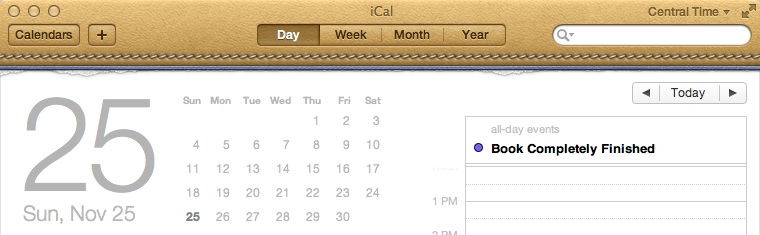
Nov 25 If you're familiar with Myers-Briggs terminology, I'm a nearly off-the-chart P. I like to go with the flow and take things pretty easy, and I don't like deadlines. But to survive in a work environment where an organization exists for more than going with the flow, I've had to learn some J skills. These days in my life, I love setting my own schedule, but... the kind of flow I'm comfortable going with could slow down to where its movement is almost imperceptible to the naked eye. That wouldn't bother me much, but it also wouldn't help this book project get done.
So I'm giving my J side a workout and actually (painfully) setting myself a deadline. If I was working with a traditional publisher on this, that would certainly help get it done. They would give me a deadline, and I would have to stick to it. But since there's no one who will ever be barking at me to get this moved past the finish line, my hope is that by unnecessarily posting this information publicly to the galaxy, a couple of you might love me enough to bark if the book isn't done when this date comes around.

So here it is: The book, Live Prayerfully, will be completely finished by Nov. 25, 2012. This is pretty ambitious, but I think it's possible. Since I've taught the material of the book a few times on retreats, it's almost all written. My only task is to change it from speaking notes into book chapters and add some parts where needed. I'm about 90% there now, so that part of the project is doable. It also means I need to go ahead and make some contacts with people who might be able to do the book cover, final edit, and anything else for which I'lll need the help of someone who really knows what they're doing.

I know it's easy to underestimate how long things will take, but I'm also grateful to already have a much smaller DIY self-publishing experience under my belt with Understanding Infant Baptismso I think I've got a decent idea of the steps involved. We'll see.

So why Nov. 25? A few reasons:

  • The main content of the book will be offered again through our church early next year, hopefully in January, and it would be helpful to have for people by then.
  • Also, our church will have a year-long emphasis on prayer in 2013, so I hope to be guiding folks through the ideas in Live Prayerfully in other settings as well next year.
  • That emphasis in our church has given me the idea for the next thing I want to write: A Year of Living Prayerfully, in which I would chronicle a year of going to the most reasonable extreme of organizing my life around the ways of praying described in Live Prayerfully. For a variety of reasons, it would make a lot of sense for me to start that project during the first week of Advent, so I've backed this new deadline up a week from that, and we have Nov. 25.

Oh man. I really don't like deadlines. And I really don't like announcing a self-imposed, not set in stone deadline to the world.

Book Review: How God Became King by N.T. Wright

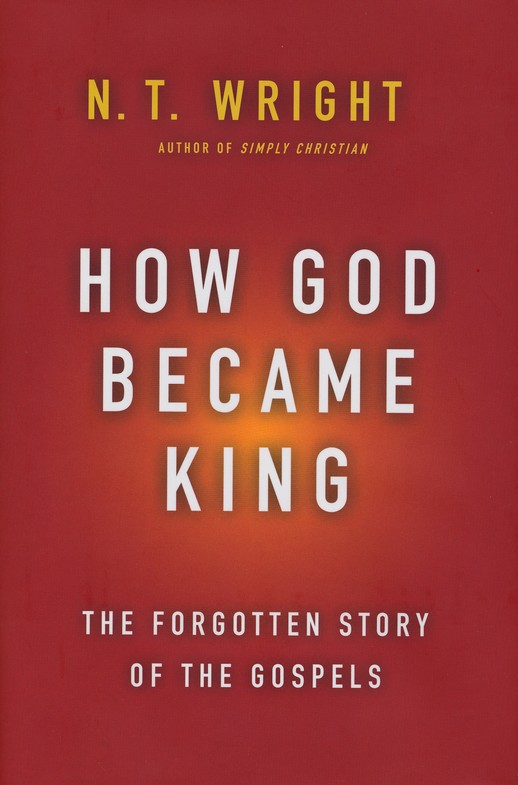
Book Cover- How God Became King I will never read the gospels the same way again after reading How God Became King by N.T. Wright. I am not new to reading Matthew, Mark, Luke, and John, but this book helped me to see things in those four books which I have missed in all of my previous reading of them, even as they have been my constant companions for years. And the things it helped me to see are not just trivial matters, like trying to unlock some secret code hidden in these ancient documents, but rather, they are the essence of what all of the four gospels seek to communicate. I am not alone. As he says early in the book, "Despite centuries of intense and heavy industry expended on the study of all sorts of features of the gospels, we have often managed to miss the main thing that they, all four of them, are most eager to tell us."

A subject that runs throughout the book is how Christians manage to deal with the different emphases of the traditional Christian creeds and the content of the story of Jesus' life in the gospels. Other than Jesus' birth, death, resurrection, and ascension, the creeds have practically no mention of Jesus' life, and a straightforward reading of Matthew, Mark, Luke and John leaves no doubt that the things Jesus did in his life (particularly in between his baptism and Good Friday) really do matter. I know no one who denies that explicitly. Yet I know many (and have been one myself in the past) whose theology could skip straight from Christmas to Calvary and not miss anything. Wright's point is that such theology may be consistent with the creeds, isn't consistent with the gospels, and that the creeds and gospels do not have to be separated like that, but can and should compliment each other.

Wright's claim that Jesus becoming king is the point of the gospels may not sound all that shocking to readers upon first glance, though many might think that Matthew is "the kingdom gospel," while the others have their respective emphases. But Wright does a masterful job of showing how each of the gospels is thoroughly a gospel about God becoming king (of Jesus' ancient Israel, and of the world) through Jesus. In order to make sure his argument suffers no injustice, I won't try to summarize it here, but will simply urge anyone who has an inkling to do so to read this book.

I first read Dallas Willard's The Divine Conspiracy in the summer of 2000. The way I live and what I believe has never been the same since. This book by Wright has been part of a Willard-esque revolution in my understanding of the gospel. Much of the point of Willard's message is that we have to evaluate whether the gospel we communicate naturally leads our hearers to become disciples of Jesus, or to become something else, and that if we are to be faithful to the scriptures, our gospel has to be filled with the message of God's kingdom. Even though that concept forever changed my approach to life and ministry, I have always struggled with how all the parts of the scriptures might form a kingdom-centered gospel which naturally leads people into discipleship. This book makes a huge stride in that direction.

Disclosure Statement: If you purchase resources linked to from this blog, I may receive an “affiliate commission.” I am disclosing this in accordance with the Federal Trade Commission’s 16 CFR, Part 255: “Guides Concerning the Use of Endorsements and Testimonials in Advertising.” Regardless of whether I receive a commission, I only recommend products or services I use personally and believe will be good for my readers.

Prayer All-Stars, Why I'm Not One, and Why That's Okay

[I'm working on finishing up drafts for the chapters to Live Prayerfully: Three Time-Proven Ways Ordinary Lives Become Prayerful. The general of the aim of the book is to provide guidance on historic practices of prayer in simple ways. Below is an excerpt from a section of the third chapter (Praying With Your Own Words), which discusses why it's okay if we don't have some of the same kinds of prayer experiences as famous Christians.] One of my favorite stories about a prayerful person is a story about George Mueller. Some of you may recognize his name. He became a fairly well known for his work with orphans in the 1800s in England. He decided from the outset of his ministry that he would never ask for financial support for his orphanage. He would simply ask God to provide for his needs through prayer, and trust that God would do so.

By the end of his life, Mueller’s orphanages had cared for more than 10,000 children, and he established 117 schools which provided education to more than 120,000 kids. He was so effective at providing an education to poor children that he was actually accused of “raising the poor above their natural station in life.” And all of this was through a man who was radically dependent on God and was extremely prayerful.

The story goes that Mueller was on a ship that was sailing for America, when they came into a dense fog.

“Because of it the captain had remained on the bridge continuously for twenty-four hours, when Mr. Mueller came to him and said, ‘Captain, I have come to tell you that I must be in Quebec on Saturday afternoon.’ When informed that it was impossible, he replied: ‘Very well. If the ship cannot take me, God will find some other way. I have never broken an engagement for fifty-seven years. Let us go down into the chartroom and pray.’

“The captain continues the story thus: ‘I looked at that man of God and thought to myself, What lunatic asylum could that man have come from? I never heard such a thing as this. ‘Mr. Mueller,’ I said, ‘do you know how dense the fog is?’ ‘No,’ he replied, ‘my eye is not on the fog, but on the living God, who controls every circumstance of my life.’ He knelt down and prayed one of those simple prayers, and when he had finished I was going to pray; but he put his hand on my shoulder and told me not to pray. ‘Firstly,’ he said, ‘because you do not believe God will, and secondly, I believe God has, and there is no need whatever for you to pray about it.’ I looked at him, and George Mueller said, ‘Captain, I have known my Lord for fifty-seven years, and there has never been a single day that I have failed to get an audience with the King. Get up and open the door, and you will find that the fog has gone.’ I got up and the fog was indeed gone. George Mueller was in Quebec Saturday afternoon for his engagement.” 

(Glenn Clark, as quoted in A Guide to Prayer for Ministers and Other Servants by Rueben P. Job)

Isn’t that great? I love to read the stories of some of the “prayer giants” like that. For more than 50 years, John Wesley awoke between 4-5 a.m. for prayer. He said that he often had so much to do in a day that he could not afford not to spend at least three hours in prayer.

I have read stories about men and women like that for years, and for a long time I imagined that if I was ever going to be teaching others about prayer, my doing so would be full of stories like theirs, trying to inspire us to imitate their efforts.

The main obstacle that keeps me from trying to inspire others to imitate the efforts of the Muellers and Wesleys of history is simple: I can’t imitate their efforts. I tried to pray like Wesley once. I gave up on day two, because, man, I was tired. To be someone who prays for hours every day, and sees things happen like fog disappearing from Mueller’s ship... I have started to believe that those kinds of experiences may not be for me, nor for most of us. And it’s interesting that while Wesley and others like him certainly urged others to pray, they generally never encouraged others to pray in the ways that they did.

So, at this point in my life, I think I’m okay never making it into the prayer hall of fame. I don’t need to become a superhero and have extraordinary experiences. Instead, what I really, deeply desire is simply to keep becoming a more prayerful person. Remember again the story of Albert Haase from our Introduction, whose spiritual director told him, “The point of praying is to make us prayerful people,” meaning that the point of the times that we spend set aside for prayer is so that we will be more able and likely to pray and be aware of God’s presence through the rest of our day. We pray during some parts of each day so that the rest of every day can be lived prayerfully

Therefore, please understand that we don’t do the kinds of things we discuss in this book in order to try to become the prayer all-stars. Rather, my hope is simply that we can learn time-proven ways of praying that have been helpful to other followers of Jesus for a very long time, some of whom we may know their names, but the huge majority of whom were never known beyond the people right around them.

I still think it’s good to be inspired by stories of people like Mueller or Wesley, but I hope that none of us have prayer’s equivalent of football’s all-pro quarterback in mind when we think of what it would mean to live a prayerful life. If we’re going to associate a word with the lives of God’s prayerful ones, I think it is much more helpful to us, and much more consistent with the message of the scriptures, to get rid of images and words like superstar or hero, and replace them with another, much simpler word: friend.

...

Why Our Own Words Matter

Tonight, I thought of a story about my son that I wanted to work into the Live Prayerfully chapter on praying with our own words. When I sat down to start writing it, I thought I may have used the story in some way on the blog before, and sure enough... not only had I already used it, but I had also already connected it to praying with our own words. Man, a blog can be handy.

So this post is really just a link to an old post: If You Were Going Somewhere By Yourself, I'd Want to Catch Up.

Excerpt from Chapter 1: Praying With Other People's Words

[I'm working on finishing up drafts for the chapters to Live Prayerfully: Three Time-Proven Ways Ordinary Lives Become Prayerful. The general of the aim of the book is to provide guidance on historic practices of prayer in simple ways. Below is an excerpt from the first chapter (Praying With Other People's Words), which discusses many of us already come to this kind of prayer with a bias for or against it.] If you were to walk through my church’s building about five minutes after the beginning of our worship services, on one end of the hallway you would hear a huge pipe organ booming as that part of our congregation sings a hymn that is likely to be three to five hundred years old or older. Other parts of their worship service will likely include things like the people up front being in robes, praying by saying aloud one of the responsive readings from one of the Psalms in the back of the hymnal, or banners hanging in the sanctuary that have to be certain colors at certain times of the year.

If you would normally prefer to worship at this end of the hallway, my hope is that this chapter will add depth of meaning to some things you likely do in worship already, and help you to see ways that we could become more prayerful people by carrying those practices into our the other parts of our days and weeks.

However, the worship service taking place at the other end of the hallway is very different. If you were to walk toward it, you would hear music equally booming, but this time coming from a drum set, guitars, and electric keyboards as that part of our congregation sings a song that is likely to be six months to a year old or newer. Other parts of their worship service will likely include thing like the people up front being in jeans, every prayer said being made up on the spot by the person saying it, and various multimedia images being projected on the majority of the wall space visible throughout the service.

If you would be more likely to find yourself in the drums and multimedia end of the hallway, thank you for at least reading to the fourth page of this chapter before skipping ahead in the book. Hang in there with me, because my experience is that you are likely to find at least as much depth of meaning in this way of praying as your friends down the hallway.

I mention this because I am well aware of the potential that some of you may already be turned off to this chapter just because of its title. If that is you, it’s okay that you feel that way, and there is likely some good reason that you do. I am more of a newcomer to intentionally using this kind of prayer than the others that we will explore in this book, so I think I understand your hesitations. Yet I include this way of praying, and I include it first, for some important reasons. First, I have found this way of praying to be very life-giving to me personally, and as I have taught this material to others in classes and retreats, this way of praying is the one where people most often describe a light bulb coming on inside of them. One woman stopped me after we opened a retreat by teaching on the topics in this chapter and said, “Even if we didn’t do anything else after that, I’m glad I came.”

(I wanted to stop the retreat right then, realizing the mistake I had made in setting people up for disappointment in the remainder of the things I had to say, but it all ended up okay.)

So, if you are one for whom the title, “Praying With Other People’s Words” fails to light a light bulb or anything else within you, remember the advice of Albert Haase’s spiritual director that we considered in the Introduction, “Find the way of praying that works for you,” the way of praying that helps you to be prayerful, and do so by trial and error. If praying with others’ words isn’t something that you think makes you tick, I am only asking you to hang in there with us through the end of the book and experiment with how each of these ways might help you become a more prayerful person.