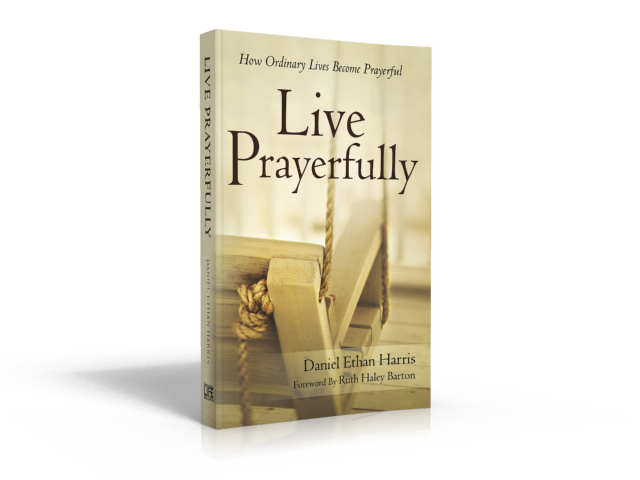
Wait Prayerfully: A Guide to Prayer for Advent

Wait Prayerfully Cover Shot Print-Kindle  

Advent is a time when Christians all around the world practice waiting prayerfully on the Lord. We remember the prayerful waiting of God’s faithful people for the Messiah to come, and we remember the calls to be watchful as we wait for his reappearing. This guide will assist you in preparing your soul for Christmas this year by helping you to wait prayerfully.

Designed to be useful on its own or as a companion guide to Live Prayerfully: How Ordinary Lives Become Prayerful, this book leads the reader into ways of praying with other people’s words (based on prayers adapted from The Book of Common Prayer, praying without words, and praying with their own words, including scripture readings, hymns, and prayers which are particularly helpful during Advent.

Now available in print and Kindle editions.

Click here to see all titles available from SalvationLife Books.

Two New Resources Coming in November from SalvationLife Books

I'm excited that two new resources will be available in November 2013 from SalvationLife Books:

  • Follow: 40 Days of Preparing the Soul for Easter contains daily readings and prayers for the season of Lent. (This will be the published version of last year's 40 Days of Prayer series.)
  • Wait Prayerfully: A Guide to Prayer for Advent is designed to be useful on its own or as a companion guide to Live Prayerfully: How Ordinary Lives Become Prayerful.

Both of these titles will be published in print and Kindle editions and will be available through this site and Amazon.com.

Wait Prayerfully-Follow Cover Shot

In Memory of Charlene Hendrix

My wife and I–and many others–lost a friend over the weekend in Charlene Hendrix. We attended her funeral service this morning after having had a very enjoyable visit with her less than two weeks ago. She knew that she was dying of cancer when we visited her in her home, and perhaps she knew that the time might have been this close, though we sure didn't. My comment to my wife when we left her house was, "I've never seen a dying person smile so much." I've heard it said that by age 40 or 50, we all have the faces we deserve, and Charlene's smile at age 81 even while being eaten up by cancer was like few that I've seen at any age, and it was fitting since it reflected a remarkable degree of "the life that truly is life" which was in her for decades.

The first time I remember meeting Charlene was when she took a class I was teaching on Wesleyan theology. She loved to learn, and never gave it up. It wasn't long after that class that I began writing on this blog, and Charlene was one of my earliest encouragers. I used to have something in the sidebar that could display the people who had commented most often, and her name was always on the list. We never forget the people who have really believed in us and given us encouragement when we needed it, and I will not forget hers.

Every one of us is currently in the process of becoming the kind of person we will be when we arrive at our deathbed. The decisions we make today inevitably push us toward becoming some kind of person then, so we are wise to pay attention to the course which that process and those decisions are taking. Charlene lived that process well, constantly filling her mind with things that nourished her soul–whether reading the Scriptures or taking photographs in nature, practicing habits that were conducive to God's life growing in her, and engaging in relationships with others that helped her to continue to grow and through which she could be a blessing.

James Bryan Smith has said, "the true sign of sanctity is not seriousness but joy," and I want to follow the kind of road Charlene followed for so long, one which will naturally leave me like her: someone marked by a joyful confidence in God.

FAQ for Live Prayerfully Online Class

I am eagerly looking forward to launching an online class based on Live Prayerfully on Monday, October 7. The four-week class will be a helpful experience for everyone who participates, as we will each dig into the chapters of the book together through discussion online, experience the three ways of praying described in the book by experimenting with them in our own lives, and be encouraged by reading the thoughts and comments of our fellow participants as we all do the same things together. In talking about the class with a few folks, I thought an FAQ section might be helpful (if I left anything out, please let me know in the comments):

Will there be any tests?

No tests, papers, or grades. Perhaps I should find a better term than "class" to get rid of the academic associations that come to mind for many of us, but I haven't thought of anything that fits better yet. It will consist of reading the chapters in Live Prayerfully, practicing prayer in the ways described there, and then processing our experiences together through online discussion.

Do I have to be online at any certain times?

No, you can participate according to your own schedule. Since the class consists of online discussion, when you will log in and participate is completely up to you. The only effect that time will have on the class is that the topics we discuss will change by week.

Will there be any videos to watch?

No–just reading the book and discussing it online.

How much work will it be?

One of the things I have tried to emphasize in the book is that learning to live prayerfully isn't something that is burdensome and adds a lot to our schedules and to-do lists. Rather, many of us already pray in some way, and I don't think it takes any more time to pray in the three ways we'll explore together than it does to pray in just one of them. So, experimenting with the ways of praying in the book will be the majority of the "work" for the class. The only other expectations are that you will read the chapter we are discussing each week, respond to one discussion question, and reply at least once to someone else in the group.

Is it worth the money? Can't I get the same information through the book, without the extra cost of this class?

Up until now, my favorite setting for teaching on this content has been on retreats. I think this class will be just as helpful to everyone, with less expense and no need for anyone to travel.

While the chapters and prayer guides in Live Prayerfully are the main content that we'll look at together, the book alone can't provide a couple of things which this class can: First, covering the chapters according to a week-by-week schedule makes it much more likely that we will practice prayer in the ways described. (I've read a lot of books which had suggestions I liked, but never really tried. This format will help us overcome that tendency.)

Second, connecting with others who are seeking to connect with God is indispensable, and an online class is a great way for people to help one another make progress in our lives with God. I really enjoy the dynamics of online discussion. In a traditional classroom, a few students usually make the large majority of the comments and questions, but in an online class everyone's voice is equalized. I became convinced of this while doing some of my graduate studies online, where I thoroughly enjoyed the community that developed between us as classmates even though we had never met face to face.

And, of course, if anyone goes through the class and concludes that it really wasn't worth the $35, I'll be glad to refund their cost.

How does payment work? Isn't it unsafe to pay for things like this online?

All of the payment is handled through PayPal, which is the world leader in processing online payments. Whenever someone clicks the button or link to register, they are taken to a secure PayPal site, where they can either pay using a credit/debit card or a PayPal account.

Have other people found this helpful?

This is my first attempt at doing this class in an online format, but it has previously worked well in retreats and church classes. Here is one of my favorite comments from a past participant:

“I took the class at a time when I was in a spiritual slump. The class gave me tools and guided me into a renewed prayer life that got me out of the slump and, over a year later, still has me going and growing.”

What are you going to do with my personal information?

I will need participants' names and email addresses, which is the only information I will collect. I'll never give that information away to anyone else, and the only reason I will ever use it would be to follow up on the class. As far as anything said in the online discussions, the site is password protected and invisible as far as cyberspace goes, so no one will ever find it on an internet search, etc.

Okay, count me in. What do I need to do next?

Registration is $35, and you can register now by clicking here. Registration will close on September 30 or when the spots are filled. I will then contact everyone participating with the details of how to log in to the class, which will begin on October 7 and end on November 3.
New Online Class: Learn to Live Prayerfully With Others

Final Cover Image

New 4-Week Online Class Begins October 7, 2013

"A prayerful life is meant for everyone, and none of us becomes prayerful by ourselves. Perhaps the synergy that surpasses that of putting together practices of praying with other people’s words, praying without words, and praying with your own words is that of putting these practices together with others. It might be on a retreat, in a small group, or with your family, but the only way we are meant to live prayerfully is to live prayerfully together." -From the Conclusion of Live Prayerfully

I hope that you will consider joining me and a small group of others as we explore together how we can practice prayerful living. In order to do this, we will begin a 4-week online class, limited to a small number of participants.

Each week, we will take a section of Live Prayerfully, discuss it together online, and use the Guides for Prayer in Part II of the book to shape our praying in the same ways together throughout the class. The class outline is:

  • Week 1: October 7-13 Introduction: Searching for Simple and Reliable Guidance in Prayer
  • Week 2: October 14-20 Praying With Other People's Words
  • Week 3: October 21-27 Praying Without Words
  • Week 4: October 28-November 3 Praying With Your Own Words

The online format of the class means that participants will be able to take part in the class according to their own schedules. Each week, we will all read the corresponding part of the book early in the scheduled week. Then, each member of the class will be asked to contribute in the following ways:

  • Briefly answer one of three reflection questions and post your response.
  • Read your classmates' responses and reply to at least one of them.
  • Practice praying in the week's respective method.

I look forward to getting to know and actively engaging with each participant.

What you will need:

  • Registration is $35.
  • A copy of Live Prayerfully (Either a print or Kindle version is fine. This is not included in the registration cost, since some participants will already have a copy.)
  • Basic ability to use the internet. If you are able to do something like respond to a blog post, you will be fine. (If you're not sure how to do that, here is one of my favorites–read it and try your hand at commenting!)

Please consider joining us as we learn together to live prayerfully. Registration will close on September 30, or when all spaces are filled.

(Registration is now closed.)


Sweeter Than Honey? Really?

[I am preparing to lead a retreat this weekend called Open [to] the Book, which focuses on ways that we can approach the Bible in order to allow it to take its full intended effect on us. Below is an excerpt from the first session.] I remember a point when I was freshly out of college and in my first years on staff at a church. It was a period of my life when I had begun digging in to great books on prayer. I was discovering Richard Foster and Henri Nouwen and others, and I loved their teaching and I was growing. But then it hit me one day that something wasn’t right: I was beginning to love prayer, but when it came to the Scriptures...well, I could preach and teach from them, but I didn’t love them. I knew that wasn’t good, but it was honest.

I think that's something of an "elephant in the sanctuary" even in churches that claim to be the most Bible-focused. An attitude like that can be pretty common, possibly even for a majority of the people there. If we were asked, “Do you center your life around the Scriptures,” we would likely say yes–at least to some degree. But if the question changes to, “Do you really like the Scriptures?”...we might plead the Fifth Amendment.

My hope is that wherever you find yourself along the spectrum–if you’re in a period of life where the scriptures are pure treasure to you, or if right now they seem to you about as dry as the pasture that my cattle call home–that we’ll be refreshed and in the weeks and months following this retreat, able to drink from them a bit more deeply.

–––

My wife and I lived away from Texas for eleven years before moving back. During that time, whenever we came to visit my parents, pretty much the entire diet for a week was split between my mom’s great cooking and going to our favorite restaurant, Rosa’s Café and Tortilla Factory. We just couldn’t get enough of either of them. I remember once coming home to visit for a week and we hit Rosa’s five times!

I don’t think we’ve had any five-visits-to-Rosa’s weeks since moving back, but we are still frequenters there, and we especially were as soon as we moved back to Texas. We had been living in Guatemala for two years, so Tex-Mex seemed like God’s pure glory on a plate for us. I think it may have been during our very first week back that we went to Rosa’s for lunch and it was fairly crowded, and our table was unusually close to the table of the family next to us.

As they were finishing their meal, sitting so close to them gave us a good view of an image I may never forget. They had a boy, maybe ten years old, who was doing what we usually do and finishing off his Rosa’s meal by eating one of their delicious tortillas spread with honey. However, it was clear that for this boy, the tortilla was secondary in that recipe. His tortilla was permeated in honey. I think his parents had gone from the table to get refills on their drinks when I looked over and saw him, holding the tortilla up in the air, with honey running down his arm to his elbow. Then he couldn’t help himself. He began licking his own arm, trying to get down to his elbow, in order to get every last drop of honey that he could.

That fits an image from some of the writers of scripture as they described the utter goodness and delight that they found in their scripture.

The decrees of the Lord are firm, and all of them are righteous. They are more precious than gold, than much pure gold; they are sweeter than honey, than honey from the honeycomb. (Psalm 19:9-10)

How sweet are your words to my taste, sweeter than honey to my mouth! (Psalm 119:103)

I want to look at the scriptures like that, with that delight of the boy at Rosa’s licking the honey off of his elbow. But a question comes to mind when I look at the verses above: what exactly was it that the psalmist was describing as being more precious that gold and sweeter than honey from the comb? It wasn’t John 3:16, or some of the great passages in Romans that talk about nothing separating us from God’s love. No, it was stuff like Leviticus, Numbers, and Deuteronomy. It was those sections of the Bible i that were more like eating stuff you don’t like at all but your doctor says is good for you than the ones we usually think of as being like Rosa’s honey-inundated tortilla to that boy.

So how is that the writers of these psalms could open the book to those same passages of scripture and come out saying that they were like honey and gold? Well, I think part of the answer is that they approached them very differently than we normally do, and that difference is what I’m trying to get at in playing with the title for this retreat, because not only did these psalmists open the book, but they opened themselves to it. Now, we’re not going so spend any time on this retreat meditating on passages from Leviticus, but we will try to look for some ways that we can do things to open ourselves to the scriptures and find them for the treasure that they are.