
Mia Beth
"Do not fear, for I have redeemed you; I have called you by name, You are mine." (Isaiah 43:1)

Your Custom Text Here
Mia Beth
"Do not fear, for I have redeemed you; I have called you by name, You are mine." (Isaiah 43:1)
 [This is a post on one of John Wesley's Sermons as part of the Getting to Know John series. See the other posts here.]
This is the second of Wesley's thirteen sermons on Jesus' Sermon on the Mount (Matthew chapters 5, 6, and 7). In this sermon, he continues working his way through the Beatitudes and focuses on Matthew 5:5-7: "Blessed are the meek... Blessed are those who hunger and thirst for righteousness... [and] Blessed are the merciful..."
Also, in exploring the meaning of these verses, Wesley incorporates very interesting interpretations of Matthew 5:21-26 ("You have heard it said, 'Do not murder,' but I say to you, anyone who is angry with another is subject to judgment...") and 1 Corinthians 13 ("Love is patient, love is kind...").
Continuing the interpretation of the Beatitudes Wesley began in Sermon 21, presenting them as a process that we go through in our lives with God, he begins this sermon without missing a beat from the ending of the previous one, which concluded with "Blessed are those who mourn..." This sermon then begins with explaining that once the mourning passes, and the believer again is comforted by the Holy Spirit, then they will have entered into meekness and will be able to bear witness of its goodness. Wesley characterizes meekness not as being apathetic or without a passion, but as someone who all of their emotions ("affections" or "passions") in check because of their overriding love for God and others.
Wesley says that Jesus illustrates meekness further down in Matthew 5, in verses 21-26, and so he provides an interpretation of this famous passage of the Sermon on the Mount here, rather than in a later discourse in this series. He provides a compelling argument against allowing anger into our hearts, claiming that it is allowable to be angry at sin, but to be angry at sinners can only cause damage to us and to the others.
With anger's antidote (meekness) now being in place, Wesley says that we can begin to truly hunger and thirst for righteousness, which he defines as the image of God in us and our having the mind of Christ. This hunger and thirst is from God, for God, and can only be satisfied by God. Just as physical hunger and thirst will continue to grow until the need is fully met, our hunger and thirst for righteousness will continue to grow, even to the point of our begging God that they never be taken away so that we may continually be filled with more and more of his life.
Wesley continues and claims that as God's life grows in us, so will our concern for others and we will become merciful toward them. He says that the main characteristic of the merciful is that they love their neighbors as themselves, and this leads him to work through part of St. Paul's famous "love chapter," 1 Corinthians 13. Wesley describes the merciful/loving person by examining the characteristics of love that Paul lists in verses 4-7 of that famous chapter: love is patient, kind, not envious, not boastful, not arrogant, not rude, does not insist on its own way, not irritable, not resentful, does not rejoice in wrongdoing, rejoices in the truth, and covers, believes and hopes all things.
Even if the rest of this sermon were not as valuable as it is, this exploration of what it means to love others is well our time. His explanation of what it means that love "covers all things" is something we should be taught from our first experiences in church. (It provides good, practical guidelines of how to live out my Dad's practice of never speaking badly of others.)
Wesley concludes the sermon with a powerful paragraph which is worth reading even if you don't read any of the rest of the sermon. In it, he concedes that we have ample reason to cry "Woe is me" when we consider what it means to love one another and compare it to what we see in the world around us- particularly the severe lack of love among Christians. But rather than give in to despair, he says that we should continue in hope, because God's work in history is being accomplished and we are currently being given the opportunity to be among the first fruits of God's mission of creating people who have learned how to love.
Options for digging in further to this sermon:
 Image compliments of Vanderbilt Divinity Library
[This is one of a series of Prayers for the Christian Year. To see the other posts, click here.]
Living, loving Father,
We sing praise to Your name, and we lift up our songs to You, for You are both the one who is right here with us just as much as You are the one who rides upon the clouds.
You are the one who cares for those who find themselves all alone, becoming the Father of orphans, the protector of widows, and creating a home for those who have none.
Teach us to open ourselves to the power of Your Holy Spirit in our lives, so that we may join You in this amazing work of Your love all around our world, bringing Your life to those across the earth, to those here in our community, and to those with whom we live and share our lives every day.
Although we know of Your unfailing love toward us, many of us are praying today with much anxiety in our hearts. We pause now for a moment and entrust to You the weight of these things that have been burdens to us, knowing that You care for us, You are able to provide all that we need, and You are with us.
Lord, keep us alert and aware of the ways that our enemy is seeking to destroy us, and may whatever trials we face today serve to remind us of the suffering of so many around the world, many of whom are suffering precisely because of their love of You. May Your grace be abundant toward them, and may they be confident in knowing that Your own Son will restore, support, strengthen, and establish them.
Unite us with them as we pray, so that we may be devoted to one another as we each continue to find our life in You through this gift of prayer.
You have given us more gifts than we are aware of, above all, the gift of the opportunity to know You and Your Son, Jesus Christ, whom You sent to give us the life that never ends.
Just as He did, as long as we are in this world, we will know ourselves by Your name, as Your people, and we will seek to destroy all of the things that divide us and live with one another in peace, just as we have seen in His life among us.
Until He comes back to us in the same way that He went up to sit at Your right hand, we, as His students, will continue to earnestly pray the prayer that He taught us, saying,
Our Father in heaven, hallowed be Your name, Your kingdom come, Your will be done, on earth as in heaven.
Give us today our daily bread.
Forgive us our sins as we forgive those who sin against us.
Save us from the time of trial and deliver us from evil.
For the kingdom, the power, and the glory are Yours now and for ever. Amen
Notes:
A Prayer for Ascension Day is also appropriate for use this week. The readings for this week, on which this prayer is based, are:
(Ecumenical version of The Lord’s Prayer from The United Methodist Hymnal)
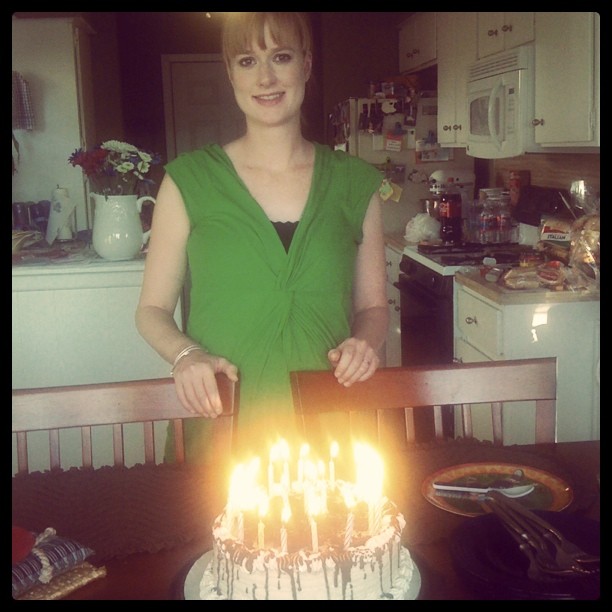 Today is my wife's birthday, and it's already been a good day even though it's had some funny pieces to it. First, she read the message that our two-year-old son wanted me to write on his behalf in her birthday card: "Thank you for my birthday." I'm not sure what he thought he meant by that, but he definitely owes her his gratitude his own birth.
The next interesting part of her birthday was that I was asked to play guitar and sing at a graveside funeral service this morning. I was happy to do so, and was very glad that she was willing to go with me, but this is certainly the first time that we have included attending the funeral of someone whom neither of us knew as part of a birthday celebration. I guess if a funeral is for remembering a life that is past and a birthday is for celebrating another year of a loved one being alive, we can find some meaningful connection between the two (but we still may not make it an annual tradition).
Then, since my wonderful in-laws are in town and offered to provide childcare so that the two of us could go out for a birthday meal, we went to the new Japanese steakhouse in town. It was a really nice place, and the food was even better. The funny part of our lunch, though, was that (because we don't have much of a Japanese population in West Texas) most of the chefs we saw in the building didn't look very natural in the Japanese outfits they were wearing. Ours was named Rodrigo. Regardless of his name or nationality, the food was good and we had a very good birthday lunch together.
With her birthday today, Mother's Day a few weeks ago, and all that she's going through being within a couple of weeks of our daughter's due date, I've certainly been thinking a lot about how much I appreciate about her, and I've noticed that blogging is helping me to learn much-needed lesson about marriage.
I have all kinds of thoughts that (in my opinion) can be turned in to great blog posts, but now that I've been putting effort into this blog for a while, I've noticed something consistent about all of those blog post ideas: the only ones that count for anything are the ones that I actually write and post. If I don't do that, I never get the joy of writing them and no one else can ever read them. Search engines have no way of indexing the content of the ideas in my head and bringing visitors to my blog just based on the thoughts that I've had; they can only bring visitors based on what I actually publish.
So here's the marriage application: I think it's common for men (especially introverted men) to fall into the habit of thinking about the things we appreciate about our wives, but not ever letting those words come out of our mouths. And since I think most men are like me in the sense of always being in favor of finding things to give ourselves credit for, we tend to believe that thinking that our wives are gorgeous, or that they're great mothers to our kids, or that they do so many things so well, or how much we enjoy being around them, or how thankful we are that they still haven't figured out that they could have married someone much better than us... we give ourselves good husband-credit for thinking those things without ever getting around to saying them.
In other words, if our marriages were blogs, most men like me wouldn't ever get around to publishing anything. Blog posts that I never publish can't help anyone, and neither do all of those things we think about why we love our wives so much help her at all, unless we get them out of our mouths so that she can hear them.
I know this isn't easy to do. I much prefer thinking to talking, but I've experimented with this lately. I recently listened to a very helpful audiobook called [amazon_link id="1590525728" target="_blank" ]For Men Only: A Straightforward Guide to the Inner Lives of Women[/amazon_link] by Shaunti and Jeff Feldhahn, and one of the things it mentions is that men have something like a 30-second window from the occasion to take the thought that entered our minds until we need to let our wives hear that thought before it loses value for her. So, this morning as we were getting ready to leave for the birthday-funeral and she walked out looking celebratory in an appropriate way to attend the funeral of someone we didn't know, the thought entered my mind, "Wow, she looks nice." Because I've been experimenting with these things, I also had the wisdom within the 30-second window to say, "You look nice."
My conclusions after a couple of months of experimenting with this:
First, I still have way too many times that I hang on to a thought and it never crosses my mind to say it with my mouth. I really have no idea why this is the case. I guess it's just as true that new habits are hard to develop as old ones are to break. But, I do say things to her more often than I used to, and that has led to the second conclusion:
She likes it. If I analyze it thoroughly enough, this makes sense. She really wants to know she's loved, and I really want her to know that she's loved, so I want to further my experiment and be sure and tell her the next time that I notice how much I like her eyes or her smile (or other things), or how much I appreciate her doing any of the million things she does to keep our lives going pretty smoothly. I need to tell her when I think all of these kinds of good things about her.
And I need to publish the blog post.
Disclosure of Material Connection: If you purchase resources linked to from this blog, I may receive an “affiliate commission.” I am disclosing this in accordance with the Federal Trade Commission’s 16 CFR, Part 255: “Guides Concerning the Use of Endorsements and Testimonials in Advertising.” Regardless of whether I receive a commission, I only recommend products or services I use personally and believe will be good for my readers.

Michael Hyatt is one of the most helpful bloggers out there, and this is pretty much a direct imitation of his, except that it has to do with my blog. I'm catching up to him in blog traffic, though, because it looks like he only has about 114,000 more people following his blog than I do...
Anyway, incase you missed any of them, here are my most read posts during May 2011:

[This is one of the posts telling a story from the life of my Dad. Click here to see the others.]
Regardless of who you are, if you ever wronged my father in some way, I don't know about it.
I've already mentioned this characteristic about him in my tribute from his funeral service, but it's so remarkable that I think it's worth telling again in a fuller way. One of the things that I came to admire most about him was that he literally never spoke negatively of other people (with the only possible exception being some of his comments about politicians he disagreed with). "Fuddy duddy" was about the most negative descriptor of a person that I ever heard come out of his mouth, and he never elaborated with anything else negative, so I'm still not sure what exactly Fuddy duddy means.
For longer than I've been alive, the hat rack pictured above has hung in my parents' house. My Mom found the piece in the center, and my Dad's mother, who was a very good woodworker, added the mirrors and other pieces to turn it into a hat rack. Think of how often we would have to hold our tongues (and often find it really hard to do so) if we were to live out its inscription: "No one who speaks ill of another in that other's absence is welcome beneath this friendly roof!"
Yet my Dad lived out the inscription and went a couple of steps further; it didn't matter if the person was absent or not, nor under what roof we found ourselves, he apparently never saw the value in speaking negatively of other people. In the days following his death, his youngest sister attested to this as she shared pictures of the two of them together as children (including the one below) and said, "I do not remember one angry, even irritated, word from him towards me, ever, which considering he was seven years older and I was undoubtedly a pest, is amazing."

Perhaps it was easier for my Dad than most people to avoid all negative talk toward or about others, because, well... he didn't say much of anything. But, I've also known quiet people whose only words were complaints, while my Dad had no problem telling about good things that others had done.
Remembering this about him has made me reflect on a couple of things: First, I'm very thankful for it, because he left me able to see the good in my relationships with people, even if they were people with whom he may have had some negative experience in the past. Like any good father, he had his ways of influencing who I spent time with and who I didn't, but he never felt the need to bad-mouth someone in order to accomplish that. So, if you were someone who had a difficulty with him at some point, and I now have a good relationship with you, we both owe him thanks. I likely would have had my self-defenses up against you if he had ever felt the need to criticize you.
And that leads to the next thought: Why do we criticize people, and how often is it really necessary, beneficial... or even, how often does it not do harm? The first reasoning that comes to mind is that we feel like we need to tell others what someone did in order to protect them from experiencing the same harm. This seems honorable at first, but I don't think that's actually our purpose as often as we might let ourselves believe.
Sure, we might be able to think of some drastic cases where that might apply: "Son, that man with the chainsaw is Bob. The last time Bob came over with a chainsaw he cut off my arm. He has terrible aim. Don't be friends with Bob." In cases like that (or cases less ridiculous, where some serious harm might be at stake), it would probably be the right thing to do to speak some negative words about Bob.
But when else is it actually the right thing to do? I think it's more likely that our negative words about others are usually our way of trying to indirectly damage them in some way without having to take responsibility for it. It doesn't take much imagination to think of harm that would be avoided in our world if we were able to cut off negativity toward others in the same way my Dad did and simply refuse to speak of it:
I'm sure you can think of other ways this would help us to harm others less and leave more room for good to be done.
But I can also think of one major problem: even if this habit of my Dad's sounds good to all of us, our mouths can be remarkably capable of letting things out before they pass through any filters we would like to have in place. So what's the answer?
Practice. Even in small things I can practice stirring compassion rather than harboring resentment: "Yes, it stinks that Bob just ate my piece of dessert, but he must be really hungry after using that chainsaw all day." I can also practice re-telling the good that people do: "You should really see how much better Bob's aim is getting. Just keep a good distance."
As we practice with the things that seemingly don't matter much, we'll find that it becomes easier to act like we intend to with the things that really do matter. Because my Dad had practiced this from the time he was a little boy, by the time I came along, it would have actually been difficult for him to come home and gripe about something someone did. Not passing it on was really easy.
So let's give it a shot: depending on how often each of us normally engage in of bad-mouthing (whether it's something you can remember doing once several years ago, or perhaps you consider it a hobby), let's set ourselves appropriate and attainable time limits to practice not doing so (maybe a 2 days, or a week, or 30 seconds), and see what happens.
Maybe repeating this to yourself will help: Don't be a Fuddy duddy.
_St.Lambertus_Fenster646.JPG) By GFreihalter (Own work), via Wikimedia Commons
By GFreihalter (Own work), via Wikimedia Commons
[This is one of a series of Prayers for the Christian Year. To see the other posts, click here.]
Living, Loving Father,
You are the great king over all the earth. You sit on your holy throne and reign over us and over all the nations, and therefore we give You our praises and our songs of joy.
Lord, open our minds today so that we can understand Your word. Give us wisdom by Your Spirit, so that we may be intelligent and discerning in knowing You personally. Give us focused eyes and clear hearts, so that we can see exactly what it is that You are calling us to do, and help us to grasp the immensity of this glorious way of life that You have for Your followers.
And as we learn to walk in Your ways, we pray that You would enable us to be your witnesses, here in our own neighborhoods, in the other parts of our land, and to the ends of the earth, so that we may be tools bringing Your grace to all of our brothers and sisters around the world, that all may know the goodness of repenting of our sins and mercifully being granted forgiveness for the sake of Your beloved Son, and our beloved Savior, Jesus Christ.
It is He who loved us with His life and death, who was raised from the dead and seated at Your right hand, who now has charge over all and whose name is above every other name, now and for ever.
Until He comes back to us in the same way that He went up to sit at Your right hand, we, as His students, will continue to earnestly pray the prayer that He taught us, saying,
Our Father in heaven, hallowed be Your name, Your kingdom come, Your will be done, on earth as in heaven.
Give us today our daily bread.
Forgive us our sins as we forgive those who sin against us.
Save us from the time of trial and deliver us from evil.
For the kingdom, the power, and the glory are Yours now and for ever. Amen
Notes:
Ascension Day is this Thursday, forty days after Easter and ten days before Pentecost. This prayer is based on the readings for Ascension Day (which can be celebrated on Thursday or the following Sunday). The readings for the ascension are the same every year:
Also, normally I base the prayers on these readings in the New Revised Standard Version. For the reading from Ephesians, I borrowed heavily from The Message.