Writing the Book

Here are some confessions: Like anyone who at least fiddles around with writing, I think I have some ideas that I could turn into good books. But, even with the millions of books published each year, that number is greatly exceeded by ideas from people like me that never actually get finished and written. I'm sure I'll always have my share of those, but I also hope that I'll actually do something with some of the ideas.

Yet it isn't easy to keep moving toward finished. I have a stellar track record of starting on things that (I think) are great ideas, but I don't think I'd get picked for anyone's team if I were only judged by the things I've brought to completion. I have a book I've been working on for... according to the calendar, it's two years now. Yikes. (If that weren't bad enough, it's been two years on a really short book.)

But the book is about three ways to pray- a type of introduction to classical methods of prayer that have helped ordinary people live prayerful lives through the centuries. The stuff has been incredibly helpful to me, and I think it will be very helpful to others, so I want to get it out there.

But I'm stuck.

Traditional publishing routes haven't panned out. (Apparently, they almost never do for someone trying to do it this way: never having been published before and having a blog readership of- maybe 30-50 of you?.) Self-publishing isn't a bad option these days, but it requires some of my own money rather than someone else's, and I always seem to find other things more fun to do whenever extra funds that come in rather than getting this idea to completion.

But I really don't want to spend the rest of my life wishing I'd written the book. I don't even want to spend another year wishing I'd written the book.

So here's the public declaration: I'm going to get the thing finished. And I'm going to get it published in some form or another. The size of the audience doesn't matter too much to me. What matters more is that it's done in a way that is helpful to people and that it can move from the wish list to the actually done list.

(You all are now my official accountability group.)

What Does it Take, and is it Worth it?

In 2006, my wife and I moved to Guatemala for a couple of years, largely motivated by the desire to be part of what God was doing in the lives of a bunch of kids at New Life Children's Home. We were at a point in our lives when we were pretty free to make a move like that. We didn’t have kids, we didn’t have any debt, we were finished with school, and when the opportunity came up, we thought, “If we don’t do this now we never will.” Our attention had been grabbed by the good ways that we had seen children's lives impacted at NLCH and we wanted to be a part of it, so we went. Like anyone would, we went into that with such high expectations. And it really was a great experience for us, but it’s almost inevitable that at some point, those high expectations are going to come crashing down with a loud thud, and for us, it didn’t take long. We had been in Guatemala three days when we both got sick, and I mean sick. Intestinal infections, amoebas, the works. Not exactly what we were hoping our first week in Guatemala would be like.

And to add to the situation, we knew that the area around where we were moving to wasn’t the safest place on earth. We felt reasonably confident in our safety on the grounds of the children’s home, but the city it’s in isn’t the kind of place where you want to spend much time out after dark. We were aware of that when we went there, but it’s a very different thing to know it and be okay with it while being in another locale than it is to be there and have trouble falling asleep because of hearing gunfire.

The rubber had met the road for us in that first week in Guatemala. We had paid a high cost to get in on something God was doing in the world. Now- was it really worth it? 

As you can imagine, we were a bit discouraged. I’ll never forget being at our lowest point one morning when one of the missionaries we were working with, who is one of our heroes, came over to check on us. She’s a nurse, so she was keeping us on the road back to health, but she also knew we were just having a hard time. My wife mentioned the gunfire to her, and she made a comment that made me mentally stop in my tracks (even though I certainly wasn’t making any actual tracks because I could barely get out of bed). But here’s what she said: “Yes, I might get gunned down in the streets of Guatemala tomorrow. But following Jesus is worth it.”

Now, let me be clear. She hasn’t been gunned down. No one from the children’s home has ever been gunned down, but she got the point of two of Jesus' shortest parables from Matthew 13:44-46, in which Jesus compares the kingdom of heaven (or what God is up to in the world) to someone who finds a treasure hidden in a field or a merchant who found an incredibly valuable pearl. Both unhesitatingly sell all that they have in order to get the things they'd found.

Our missionary friend was able to say such words because was in on God’s kingdom. She was part of what we pray when we say, “Thy kingdom come, thy will be done on earth as it is in heaven.” She was in on something God was doing in the world, and she had found it to be so good that any price that may have come along was worth it.

Being part of what God is doing in the world doesn't necessarily mean that you'll go live in a third-world country. For some, it will mean doing something like that. But what matters more than whether or not you would ever do something like that is how, in our real lives that we're really living right here and now, that you and I can get in on what God is doing, cooperate with it, and help to further it.

What would it take for you to be fully in on what God is doing, and is it worth it?

Book Review: Pursuing God's Will Together by Ruth Haley Barton

This book, with the way of life and the way of leading churches and ministries that it commends, is radically good. I couldn't agree more with the first sentence of Robert Mulholland's endorsement: "This book needs a warning label: 'Content may be disruptive to your understanding of Christian life, leadership and community.'"

The book is designed to be a guide for groups involved together in leading Christian churches or organizations. Although it could easily take years for a committed group to come to the place of experiencing together some of the things Barton describes, any group with the courage to take on the task of going through this book and facing the issues it describes will quickly taste the goodness of the kind of spiritual leadership in community which it commends. Barton writes not only as a theorist who has worked hard to develop a sound approach to discernment, but also as a practitioner who has ingrained these principles and practices in her own organization and as a guide who has helped many others find their way through them.

Two-thirds of the book are dedicated to how individuals who make up a leadership group can become a community that is capable of knowing and doing the will of God together. As Barton emphasizes, it is futile to expect that discernment will genuinely happen in a community of undiscerning individuals, regardless of how sound the process may be. On the other hand, if a group is made up of discerning people, discernment will begin to happen even with very imperfect processes. The final third of the book is dedicated to a process that groups can go through as they face decisions which require discernment and what it would actually be like for them to experience doing God's will together after having discerned it in such intentional ways.

Having been involved in leading Christian ministries over the past sixteen years, and having had the privilege of working alongside many wonderful and godly people along the way, my honest reaction to reading this book is both a grieved realization that I have never experienced anything like what it describes (and neither have the large majority of my colleagues) and a deep longing to one day be part of a community dedicated to living together in the ways Barton discusses which would keep us open and available to God, so that when we come together around the common purpose of our shared ministry, we could seek to know and do God's will in such deep trust toward God and one another.

For anyone involved in leading any kind of Christian group (perhaps even right down to our families!), I cannot express sufficiently how highly I recommend Pursuing God's Will Together.

When God Does Not Respond

[This is one of the posts telling a story from the life of my Dad. Click here to see the others.]
[This is also part of a sermon I preached on Father's Day 2012. Click here to listen to and/or download the audio.]

After I graduated from high school, I lived other places for 11 years, and when we did move back to my hometown, it was a surprise. So for those years of living away, I really thought that my years of living close to my Mom and Dad were behind us and the thought of that was often very difficult for me. Even if you didn't know him, if you've read any of these other posts about my Dad, you might be able to guess that he never was much for talking on the phone, and since we only got to come home and visit once or twice a year, I really missed being with him.

My Dad was impossible to buy presents for. It’s not an exaggeration to say that there were times when we would open presents on Christmas morning in our living room, he would open his, say thank you, then put his gifts neatly in a stack to the side of his chair. And, literally, you might come back two months later and those presents would still be neatly stacked there by the side of his chair. It was just impossible.

So one year while we were living away, his birthday was coming up, and I didn’t want to go through the gift game with him, so I thought I’d do something different and start writing him letters. My idea was that I would write him a letter each month, and though I didn’t keep that up very long, I did end up writing several to him.

I had come up with this idea a bit ahead of time of his birthday, and even though I knew it was a good idea I was surprised to find myself being pretty resistant to going through with it. It wasn’t because I didn’t want to write to him- these weren’t going to be the first letters I’d ever sent him, but there was something that was different and caused me to keep putting it off.

Finally, I was able to put my finger on what was going on. I was resisting beginning to write him these letters, because the very real fear was in my mind, “What if he doesn’t respond? What if I write this, and put myself out these in this way, and his response is... nothing."

I knew that this wasn’t just a possibility, but that it was almost surely what would happen, and so I had a decision to make. Do I write the letter, take that risk, and see what happens, or do I not write it and play it safe?

Well, I chose to write the letter, and I was exactly right. He never responded.

I didn’t think about this at the time, but looking back on it now, nearly a decade later, I think I can see why I ended up being okay with mailing the letters knowing there was a good chance no response would ever come.

Think of the stories of Jesus on the last night with his disciples. He washed their feet. He took the bread and said, “this is my body, broken for you,” and the cup, and said, “this is my blood, poured out for you.” Then also, Judas has already agreed to betray him, left that meal and went to do so. Jesus, after the meal, went to a garden called Gethsemane.

It’s there in that garden that Jesus said that his soul was troubled to the point of death, where his sweat became like drops of blood, and three times he prayed that anguished prayer, “Abba, if it’s possible, let this cup pass from me,” speaking of the suffering he was about to go through.

We know that story, and are right to kind of have a silenced awe about it, and particularly about Jesus also praying, “Yet not what I will, but what you will.”

But there’s one thing about the story that I never noticed until recently. Jesus was in his worst moment, pouring out his soul to his father, and none of the gospel writers give any indication that his father responded in any way. He expressed himself to his father in the deepest way possible, and his father’s response was, apparently,... nothing. Then Jesus returned from the garden, went to face his betrayer, and the rest of the events ensued that lead him quickly to his crucifixion.

How could Jesus do that? How could he continue to walk that path, even when his father had just offered no response whatsoever to him?

In my letters to my Dad, I can look back and see now that I could make the decision to write them, knowing there would probably be no response, because of how I had known my Dad’s love in all of the years leading up to the moment that I stamped that letter and put it in the mail. I knew that even if he said nothing in response, he loved me, and I could always trust him. I could put the letter in the mail because of all of the years of riding around in the truck with him, all of the time we spent together watching ballgames, all of the pats on the back when I faced disappointments, all of the times that he told me I’d played good even if I’d just blown the game for my team. I knew he loved me.

The first book we use in our Apprentice groups, The Good and Beautiful God, talks about this with Jesus’ experience in the garden. It says that Jesus could continue to love and trust his father, even in that moment, in his father’s silence while he’d just poured out his soul, because all of his life, he had known his Abba to be loving, reliable, and faithful. His father’s love had been steadfast and unfailing every day of his life, and therefore Jesus was able to continue trusting him, even in those horribly difficult moments when all there was was his father’s silence.

Regardless of what your relationship with your father has been like, there will come a time when you feel the need to pour your soul out to God, and you may choose to do so or not. Even when we make make the brave decision to do so, sometimes God responds, but there always exists the possibility that God will remain completely silent, and if we continue in the life of seeking God, this is almost sure to happen at some point or another.

But the thing that will make a difference in that moment, and which will determine whether you continue to follow, even if a cross awaits you, is whether- in the months and years leading up to that moment- whether you’ve been with God enough to know and trust his love for you.

Things I've Learned from My Mom

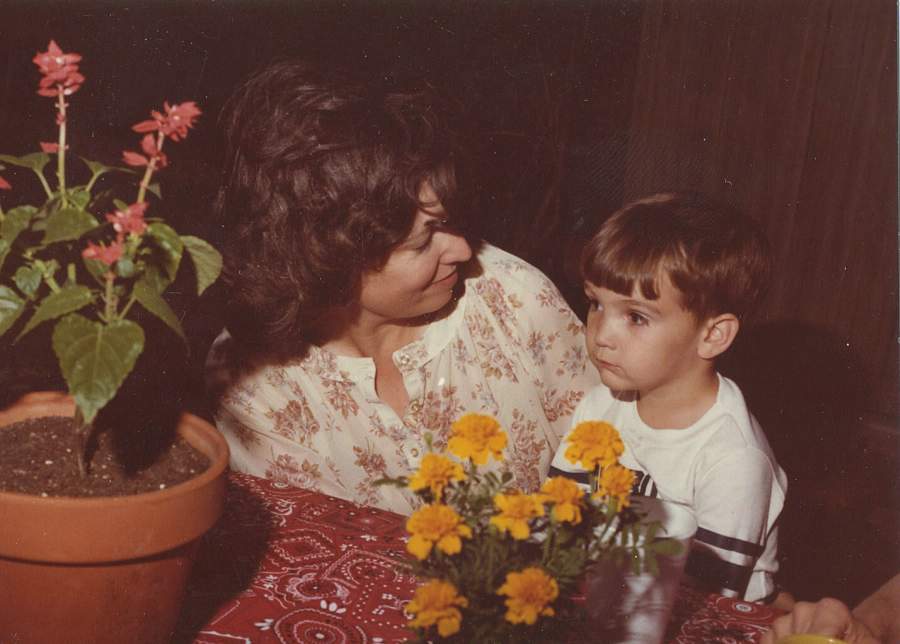
My good friend Robert preached a sermon this morning based on things he's learned from his mom, and I thought I'd contribute my version of the same theme here. I've written a lot here about my dad, partly because he's gone now and so I've been given to a lot of reflection on his life, as well as that I've written a lot about him because like being so much like him.

But I've thought quite a bit lately about how if we had personality profiles on the three of us (my dad, my mom, and me), and compared mine to my parents', my dad and I are so much alike that it might end up being difficult to know which test was mine and which was his... But, even if that were the case, the personality profiles wouldn't tell the whole story. I am very much a combination of both of my parents.

So, here is a list of a few of the things that I'm grateful have come to me through my mom (Robert preached on five things, so I'll go for that as well.):

  • She's given me a love for good books. This hasn't always been true of me, but for several years now I simply cannot read enough, and that comes directly from her. She's been a reader as long as I can remember, and everyone who knows her well knows that and is the better for it because of how she's allowed good books to shape her.
  • She's given me a love for good music. Hearing her sing is a treat. Anytime. But it's not just her talent, it's that the music she loves is so deeply ingrained in her that it's part of her. Sometimes the music we love overlaps, and sometimes not, but I wouldn't love music to the degree that I do if it weren't for her.
  • She's modeled personal devotion to God. It would be impossible to imagine the way that she lives her life without consistent and devoted reading of the Scriptures, prayer, time in worship, and commitment to her church. I can't begin to think of how different my life might be today if I hadn't seen all of these things so clearly in her.
  • She's given me permission to be public about my faith. She has influenced a lot of people through the years because of how quickly words about her own faith come up on her lips. I can't imagine that I ever would have gone into ministry, or had any desire to ever teach a class, preach a sermon, or write a blog post if I hadn't grown up seeing her inner faith and its outward displays always matching up.
  • She's taught me that others' needs come first. Growing up, and even still today, she's always the last to sit down to a meal in her kitchen, quick to jump up when something is needed, and consistently puts the things she may desire aside in order to show love to the people around her. If every child grew up with two parents who so consistently were so quick to put their own desires aside for the good of others, we would live in a very different world.

Just as it should be, I'm undoubtedly a combination of my parents, and couldn't be more thankful that in both of them I have a lifetime worth of qualities to continue growing into.

[Okay, Mom, no need to leave a sappy public comment here... :)]