
Wesley's Sermon 19: The Great Privilege of those that are Born of God

[This is a post on one of John Wesley's Sermons as part of the Getting to Know John series. See the other posts here.]

"Those who have been born of God do not sin, because God's seed abides in them; they cannot sin, because they have been born of God." (1 John 3:9, NRSV)

"So shalt thou always believe, and always love, and never commit sin."

You may wonder about the title of this sermon: What is the "great privilege of those that are born of God"? Wesley's answer: You can live without sinning again. Ever.

If you can consider any 18th century sermon interesting, you'll like this one. It's really good stuff, and even if you don't agree with it, it will make you think and ask some important questions. The second quotation above is the last sentence of the sermon, and you can see that Wesley says some big things in this message. Thankfully, he doesn't just through a sentence like that out there without laying a solid foundation first.

Claiming that Christians can live without sin has always been a tricky thing to do. (I tried it on myself earlier this year. See my New Year's Resolution 2011: Quit Sinning.) Part of the reason any of us today still know names like John or Charles Wesley, or words like Methodist, is because John made this claim very adamantly, and this sermon is one of the occasions when he did so.

The sermon has two parts, each really interesting of themselves. First, Wesley gives attention to the first phrase from the 1 John passage quoted above and offers a description of those that have been born of God. Although it is a topic he has covered in previous sermons, he goes about it very differently than he did in The Marks of the New Birth. In this sermon, rather than describing characteristics of someone who has been born of God, he describes the immense difference in their mode of existence between their lives before and after their "new birth." In shaping this description, he draws a great analogy between physical birth and spiritual birth. Although we are alive before physical birth, our senses are extremely limited, and therefore also our knowledge and interaction with the world around us, even though it is so near to us. Wesley says that it is the same with our spiritual birth; before being born of God, we are still alive in some degree, but the change in the nature and quality of our life is just as drastic at the moment of our spiritual birth as it is at our physical birth. Afterward, our senses become awakened, and we can begin knowing and interacting with the real world around us. (Read through Part I of the outline for a short, but fuller, version of his analogy- it's good stuff.)

After answering the question of what life is like for those born of God, he turns his attention to the second phrase of 1 John 3:9, and offers a case for how it can be true that those born of God do not sin. Wesley wasn't naive; he knew that plenty of people, including himself, sinned after having sincere, legitimate faith in God. So, he makes some distinctions here that very important in understanding him: between inward sin vs. outward sin, and between sins committed by notdoing something (omission) and sins committed by doing something (commission). Again, Part II of the outline is worth checking out for a fuller understanding here if you don't want to read the entire sermon, but to summarize: Wesley believed that what John meant by stating that children of God could not sin was that we cannot not commit known outward sin (instances where we know we are breaking God's law and choose to do it anyway), as long as we "keep" ourselves in God. Referring to his analogy of physical birth, we have to continue "breathing" in God, taking in God's grace, then returning all that we can to God through our lives. When we live like this, we cannot choose to go against God's commands. When we do not continue living in God in this way, all kinds of sin again become possible for us. Also in Part II, Wesley gives a very interesting progression "from grace to sin," using David and Peter as examples. Again- see the outline.

My summary is getting too long, but I couldn't help it- this is really good stuff, and Christians everywhere (particularly Methodists!) would be much better off to understand what Wesley says here. If you have any interest in Getting to know John, dig more deeply into this sermon!

Options for how to do so:

  • See my pdf outline of the sermon
  • Read the full text of the sermon electronically with my ePub file
  • Read the entire sermon online here


Book Review: Spirituality for Everyday Living by Brian C. Taylor

Like nearly everyone else I've known who has been raised as an Evangelical Christian in America, for most of my life I've known almost nothing about St. Benedict, and many of us may feel like there's not much reason to invest any of our highly valued time in changing that. Thanks to [amazon_link id="0814617573" target="_blank" ]Spirituality for Everyday Living[/amazon_link] by Brian C. Taylor, both aspects of that can change.

Much of our unfamiliarity with Benedict is due to the fact that he wrote his Rule for 6th century monks, and I have yet to go to church with many people whose lives resemble those of 6th century monks in any significant ways. So it's very helpful to have the ancient Rule of St. Benedict interpreted and adapted for us by Taylor, an Episcopal priest of our own day. He does a good job of showing how Benedict's guidance, which has proven reliable to so many for so long, can be followed by people who desire to arrange their lives around a dedicated pursuit of God yet who live in the context of family and work responsibilities.

Taylor does a remarkably effective job of communicating this in only 70 pages (including the Preface, Introduction, and Appendix!). The three short chapters of the book are arranged around different characteristics of the monastic life prescribed by Benedict: Chapter 1 describes the monk's "commitment to life": stability, conversatio (repentance), and obedience; Chapter 2 is the monk's "life in balance": prayer, study and work; Chapter 3 is the monk's "self in relationship": with God, others, and things.

Each chapter contains Taylor's summary and interpretation of the applicable sections of Benedict's Rule, as well as his own personal examples and suggestions on how people today can apply Benedict's guidance in life outside of the monastery.

I believe that one of the greatest need for Christians today is to have teachers who are effective at reconnecting us with the riches of the voices and guidance available to us from the past. St. Benedict is someone whom we will benefit from knowing and having as a teacher, and Taylor's book is a valuable resource for introducing him to today's Christians.


Disclosure of Material Connection: If you purchase resources linked to from this blog, I may receive an “affiliate commission.” I am disclosing this in accordance with the Federal Trade Commission’s 16 CFR, Part 255: “Guides Concerning the Use of Endorsements and Testimonials in Advertising.”

Regardless of whether I receive a commission, I only recommend products or services I use personally and believe will be good for my readers.


Wesley's Sermon 18: The Marks of the New Birth

"...So it is with everyone born of the Spirit." (John 3:8)

[This is a post on one of John Wesley's Sermons as part of the Getting to Know John series. See the other posts here.]

Since, in Jesus' famous conversation with Nicodemus in John 3 (the passage where we get "for God so loved the world that he gave his only begotten Son..."), Jesus said to him that no one can see the kingdom of God without being born again, Wesley asserts in the beginning of this sermon that it's really important for us to know exactly what that phrase means. He also equates being born again with other similar phrases in Scripture: being born of God and being born of the Spirit.

He then goes on to describe the three defining characteristics of those who have been born of God: their lives display faith, hope, and love. Faith is both a belief in things that are true about Christ and a personal conviction of their effects upon each of us as individuals; hope is assurance from the Holy Spirit that we are God's children we have joy now and a joyous future to look forward to; love is the greatest of all, and consists of our love for God and for everyone around us, and results in a life of total obedience to God's commandments and desires.

The sermon concludes with a very straightforward challenge to Wesley's hearers to examine whether or not these characteristics were truly part of their lives, or if they were resting too heavily upon past obedience to God (particularly their baptism).

The content of this sermon is similar to that of his previous sermon, Sermon 17: Circumcision of the Heart. Both sermons offer descriptions of faith, hope, and love as defining characteristics of true Christians. In Circumcision of the Heart, he also included humility in his list.

To dig in further:

  • Read my pdf outline of the sermon
  • Download my ePub file of the entire sermon
  • Or read the entire text of the sermon online here.

An Ever-Available Option that We Can't Afford to Choose

Several years ago, I had lunch with one of my wisest friends, Richard. I consider Richard wise for several reasons; among them are that he's found a way to make a living as an artist (not easy to do), he has a great beard, he's generally happy, and he lives his life very differently than most people I know, who aren't generally happy.

Among our topics of conversation that day was why, even among people who participate faithfully in Christian churches for the majority of their lives, some people grow to take on a significant amount of the character of Jesus and others never do. We disagreed on why this happens.

My case was, because churches generally do not do a very good job of leading people to learn reliable ways of living in the Kingdom of God (focusing more on getting people ready to die than getting them ready to live), that people are pretty much doing the best they can but have been given poor guidance. If we were to offer more reliable guidance, I thought that almost everyone would be ready and willing to walk the path of whole-life discipleship to Jesus.

Richard thought differently. He thought that people's lack of growth comes from their simple choice not to grow. Through God's grace, the opportunity has been made available to everyone, and most people just choose to say, "Thanks, but that's really not for me right now."

Now it's nearly a decade after that conversation, and I think that the best answer is somewhere between our two opinions. I absolutely still believe that churches must do a better job of seeing themselves as training centers where people learn to take Jesus' invitation to live in God's kingdom. We have to experience and teach deeper, fuller, and more reliable answers than "pray, read your bible, and go tell everyone you know about Jesus." Or, as Henry Cloud summarizes what we usually hear in church, "God is good. You're bad. Try harder."

Yet although the lack of reliable guidance is true, Richard's point is also true: God's grace (that builds Jesus' character in us) is already available to everyone, and many of us simply choose to say "no, thanks."

So, what's the explanation that accepts both sides of our conversation?

The option of not growing will always be available to us.

I continue to shape my ministry around the assumption that if leaders in churches can live, model and offer a more reliable way of living in God's kingdom, many more people will willfully and thankfully enter into it than we're accustomed to see doing so now. My dream for churches is that among the people committed to them, lives overflowing with the love, joy, peace, and hope that were characteristic of Jesus would become the norm rather than outstanding exceptions.

But, at least in our culture, I've also become convinced that the option of living another kind of Christianity will always be available. This other kind of Christianity accepts a mediocre kind of life (with one foot in the kingdom and one foot happy to remain outside) as the acceptable norm. It sees getting into heaven as the point of Christianity, rather than getting heaven into us (or, staying out of hell rather than getting the hell out of us.) It's a way for us to do enough religious things to feel like we are paying our dues or doing our duty, but to still avoid entrusting ourselves, here and now, to Jesus, his kingdom, and his way of life.

Dallas Willard calls this kind of Christianity "Vampire Christianity." In his article, "Why Bother With Discipleship?", he says, "One in effect says to Jesus: 'I'd like a little of your blood, please. But I don't care to be your student or have your character. In fact, won't you just excuse me while I get on with my life, and I'll see you in heaven.' But can we really imagine that this is an approach that Jesus finds acceptable?"

As I read the gospels, I don't see that Jesus ever intended to leave this option open to us. Rather, the only kind of life he describes and invites us to is one of being his disciple (student, follower, or apprentice), with he being our Lord and Teacher, as to how we live our lives.

Perhaps a large part of the problem is that we don't really understand how good Jesus' way of life really is, and how much we miss out on by not living it. The option of not growing will always be available to us, but we cannot afford to take it. It costs us too much life.

In one of his most often-quotes passages, Willard says:

"...the cost of nondiscipleship is far greater – even when this life alone is considered – than the price paid to walk with Jesus. Nondiscipleship costs abiding peace, a life penetrated throughout by love, faith that sees everything in the light of God’s overriding governance for good, hopefulness that stands firm in the most discouraging of circumstances, power to do what is right and withstand the forces of evil. In short, it costs exactly that abundance of life Jesus said he came to bring." (From his article "Discipleship: For Super-Christians Only?" in [amazon_link id="0060694424" target="_blank" ]The Spirit of the Disciplines[/amazon_link]).

You and I both have many choices today, and as we make them we will be headed down one road or the other: either toward a life ever more full of the character of Jesus himself, or toward something less. The good news is that God's grace and our relationships with one another provide everything that we need to consistently choose wisely, beginning right now.

Wesley's Sermon 17: Circumcision of the Heart

"Circumcision is circumcision of the heart, by the Spirit, not by the written code. Such a person’s praise is not from other people, but from God." (Romans 2:29, NIV)

(Notes: I went with a friend on my first-ever backpacking trip last week, so although last week was the 17th week of the year, I'm posting this a little late. In a couple of days, I'll post this week's sermon, Wesley's Sermon 18: The Marks of the New Birth. Also, in searching for an image to use with this post, I had the choice of searching for images about the heart or about circumcision. I hope I made the right choice.)

[This is a post on one of John Wesley's Sermons as part of the Getting to Know John series. See the other posts here.]

This sermon from Wesley touches on several things that are key to understanding him, without going into too much depth on any of them: the nature of faith, the relation of faith to works, the centrality of love, and Wesley's doctrine of assurance.

This sermon's structure is also pretty simple, as he breaks down the meaning of the circumcision of the heart with four virtues: humility, faith, hope, and love ("charity"). Then, after describing what each of these means, he lists ways that people can know if their hearts have been circumcised... If you have humility, faith, hope, and love, they have been. If not, they haven't.

Wesley also includes a great description of the ultimate characteristic of those with circumcised hearts as "having God as their chief and only end." Other traditions will describe this same characteristic as simplicity, purity of heart, or willing one thing.

If you would like to dig in further:

  • Download my pdf outline of the sermon.
  • Download my ePub file of the sermon's text.
  • Read the entire sermon online here.

What REVEAL Can't Reveal

[This is one of a series of posts related to the REVEAL Spiritual Life Survey. To see the others, click here.]

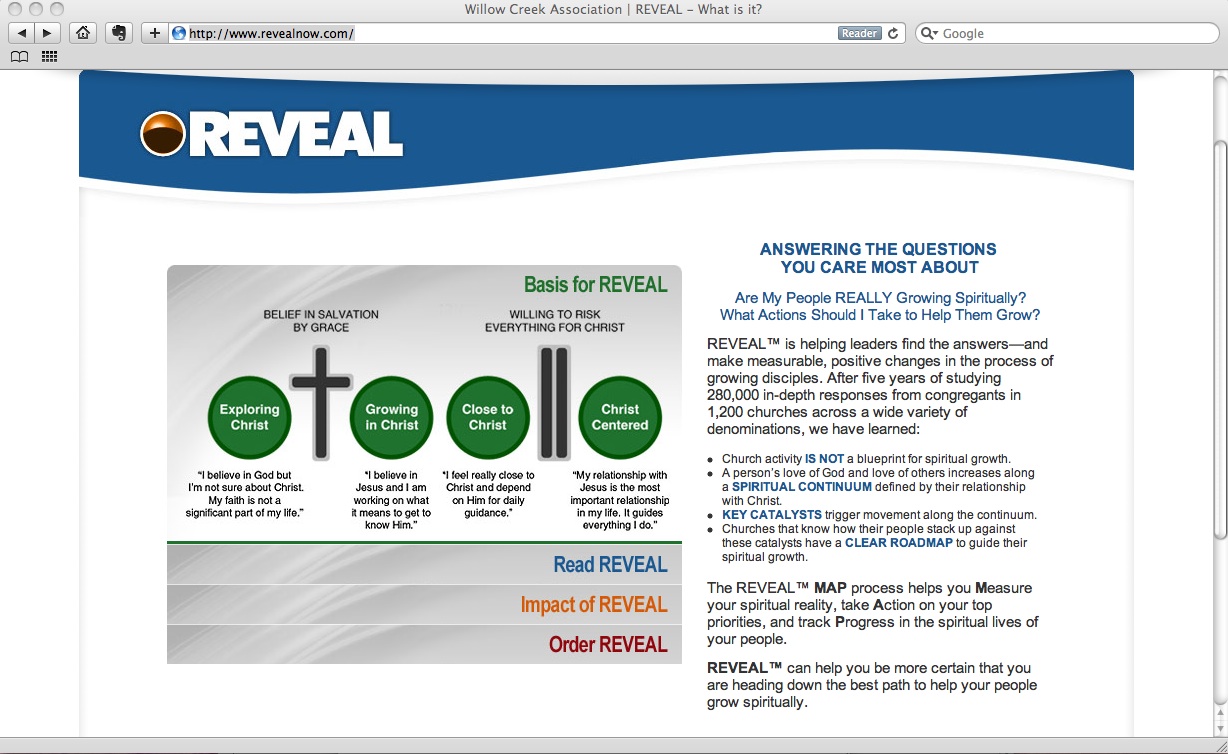
I am a big fan of the REVEAL Spiritual Life Survey produced for churches by the Willow Creek Association. I have invested a lot of my time and energy in digging into its findings and helping other people to do so; I've tried to be creative in communicating some of the things we learned by writing A Parable of Churchville; my endorsement of REVEAL is even printed inside the third book on their research, Focus. The work they are doing is unprecedented, and church leaders will be much better off to learn from their general findings, published so far in three very quick reads (Reveal, Follow Me, and Focus), as well as to see what the survey finds about their own specific congregations.

After being pretty immersed over the past 2 1/2 years in any information I could find about REVEAL as well as my own church's data, I've noticed something that's lacking. (The lack isn't in the survey, but in me.)REVEAL gives church leaders insights like we've never had before into what is going on inside of the people in their churches, what they're looking for, what they really need, and specifics about what will be most effective at helping them grow in their love for God and for other people. The problem (to no fault of the survey, because it isn't supposed to serve this purpose) is that all of these insights can keep a pastor's focus on obstacles to spiritual growth that are exterior to him or her.

In other, more direct, words, REVEAL cannot reveal any insights like these to a pastor:

  • It has been years since your church's staff members have had any time in solitude with God.
  • The speed of your church's programming schedule allows no room for you, your staff, or your lay leaders to learn the ancient discipline of resting in God.
  • Although you may be highly effective at teaching others about God and the spiritual life, rather than enjoying your own relationship with God, you use ministry to avoid ever having to be alone with him.
  • The most vital factor in a church's effectiveness at helping people to grow is the quality of your friendship with God.
  • Your staff have never learned to be discerning in their own lives and can therefore be very dangerous to themselves and others when making decisions that affect the entire congregation.

REVEAL will make a church's leadership face some great questions, like "Are the things we're putting so much time, energy, and resources into actually and predictably helping people grow?", "Which ones should we keep doing?", and "Which ones should we stop?" And the focus is certainly not all external; it does have some detailed analysis of people's perception of their senior pastor and the research lays a strong emphasis on the importance of staff modeling in their own lives how to grow.

Yet leaders who have become accustomed to looking for programmatic answers to problems before waiting on God for them will still easily find ways to focus on what the data says are the problems "out there" in the congregation rather in "right here" in the hearts and lifestyles of the people in the highest levels of leadership.

In a great article available here, Ruth Haley Barton says, "Spiritual transformation in your church or organization begins with you and your transformation. Any additional strategy must and will come quite naturally after that." Leaders should keep that constantly in mind, focusing first on helping one another learn to live more fully in God's kingdom together before digging in to all of the exterior insights that REVEAL can provide.

So, if you have any influence in your church and are someone other than one of the pastors, you can do a couple of very important things: Encourage your pastor to learn about and participate in REVEAL, if your church is not already doing so. Also, do everything possible to help your pastor(s) be assured that they are in an environment where cultivating their own intimacy with God is not a luxury for them to attend to when time is left over from the real work that they do. Rather, use your influence to communicate to them that "no time is more profitably spent than that used to heighten the quality of an intimate walk with God" (Dallas Willard- read the entire article here). As someone who is being pastored and shaped by them, your own well-being depends heavily upon this.

A very practical way to do this is to make it possible for your pastor(s) to participate in a community where their own spiritual formation is the focus. I have recently finished a Transforming Community with Ruth Haley Barton and benefited greatly from it. Renovaré and The Upper Room also have good opportunities available.

If you are a pastor, you may or may not have control over whether or not you can participate in something like this. If you can't, you must find ways to cultivate your own life with God through practices such as Sabbath-keeping, solitude, and silence, and involve others in your efforts to do so. As Dallas Willard says in his penetrating article, The Key to the Keys of the Kingdom:

A response to giving attention to personal soul care often is, “I don't have time for extensive solitude and silence. I have too much to do.” The truth is you don't have time not to practice solitude and silence. No time is more profitably spent than that used to heighten the quality of an intimate walk with God. If we think otherwise, we have been badly educated. The real question is, “Will we take time to do what is necessary for an abundant life and an abundant ministry, or will we try to 'get by' without it?”

So a couple of words of counsel are appropriate for our attending to the inner life. First, God never gives anyone too much to do. We do that to ourselves or allow others to do it to us. We may be showing our lack of confidence in God's power and goodness, though it may be that our models and education have failed us. Second, the exercise of God's power in ministry never, by itself, amends character, and it rarely makes up for our own foolishness. God's power can be actively and wisely sought and received by us only as we seek to grow by grace into Christlikeness. Power with Christlike character is God's unbeatable combination of triumphant life in the kingdom of God on earth and forever. Power without Christ's character gives us our modern-day Sampsons and Sauls.