
The Most Important Word You May Have Said Today

  Today, millions of Christians around the world have participated in a greeting very much like this:

Greeting: Christ is risen! Response: Christ is risen indeed!

Perhaps you were one who said this. We call this the Paschal Greeting, and it has been said by Christians to one another on Easter morning (and other days) for centuries, in hundreds of languages. While all four of the words carry significant meaning, the word that caught my attention as we said it today was the last one: "indeed."

"Indeed" says that this really happened, and that all of the Christians who have said it to one another throughout all of their times and cultures have done so for a specific reason:

Because there was a historical Sunday morning, when a real woman with a shady past went to look for the physical, human corpse of a Jewish teacher from Nazareth whom she had seen be executed and laid in an actual tomb, but the body was not there.

And Christians like me have said these words to one another for so long, and included the word "indeed," because we believe that he who was dead really was alive again. "Indeed."

I'm very glad that someone centuries ago thought it important to include "indeed" in this greeting. It means that we are not saying to one another:

"Christ has risen! Maybe so!"

nor: "Christ has risen! Doesn't that sound nice?"

nor: "Christ has risen! And it makes me feel so good!"

nor: "Christ has risen! And the moral of the story is..."

No, when we say these words, we are saying that a day actually happened when, if we would have been there, we would have seen it with our eyes.

"Indeed" really matters, because it reminds us that as much as theology is important stuff in Christianity, so is history. If Christ's rising were not "indeed," there should be no Christianity, and we should give up our 21 centuries of fascination with this rabbi. But if it happened "indeed," everything else about our lives needs to be evaluated in light of what Mary Magdalene experienced that Sunday morning near Jerusalem. We need to start and end all of our theology by looking at this man who lived, died, then was alive again. Because he was human like us, we need to learn to live the way that he showed and taught us, and because he was uniquely divine, we need to remain focused on him as on no one else.

What difference would it make to you if we didn't say "indeed"? What else does "indeed" mean to us?

I Would Have Been on the Wrong Side of This

As we have moved through Holy Week so far, particularly through Maundy Thursday last night and Good Friday today, I've been dwelling on a couple of things:

First, I've never noticed before how fast things happened. Perhaps that's because as we read the gospels, the events of yesterday and today take up a lot of space. Compared to the speed of the narrative of most of Jesus' life, once we get to Thursday and Friday of this week, the speed of the narrative slows dramatically, particularly in John. Of the 21 chapters, 1/3 of them (chapters 13-19) are filled with the content of these 24 hours.

This makes the pace seem slower when reading the story, as we read about Jesus getting passed back and forth between people, Pilate trying to figure out what to do with him, and the religious leaders working the political system to get their desired result ("You are no friend of Caesar... We have no king but Caesar."). Yet despite the change in pace of the narrative, the reality is that Thursday evening Jesus was having dinner with his friends- including Judas. By mid-afternoon on Friday both Judas and Jesus were dead. It happened very fast.

As I've tried to let these stories sink in and picture the scenes of the Last Supper, Jesus' trial with the Sanhedrin, Peter's denial, the crowd's choice of Barabbus and insistence on Jesus' death, I've realized something: If I had been there and been a character in the story, or even just a face in the crowd, it's silly to think that I would have done anything differently from what everyone else did. I too would have been on the wrong side of the story and left Jesus alone.

I might have been one of those who loved Jesus but for various reasons couldn't do anything about what was happening, and therefore had to let it happen. Those such as Mary his mother, Mary Magdalene, John, Joseph of Arimathea, or Nicodemus surely hated what they saw happening but felt some inevitable sense of resignation to the way things were playing out so quickly.

Or I might have been someone who more actively turned my back and ran from Jesus, like most of his friends. I may have even done what Peter did and tried to cover up any tracks that I'd had with him. Based on my own history in circumstances much less intense that what Peter faced that night, I don't have much reason to think I would do any better than he did.

Or I might have been Judas. It's easy to believe that I could have been more interested in my own plan than Jesus' way of getting things done. Like Judas, I too have been disappointed with God at times, feeling that he didn't come through as he should have, so who's to say that I wouldn't have been the one to seek personal gain as a result of Jesus not turning out to be and do what I had hoped?

Regardless of what role I would have played, I would have been among those included in Jesus' statement, "you all will leave me alone. Yet I am not alone, for my Father is with me."

I would have been somewhere on the wrong side of this horrible drama. And Jesus would have known that, and even in his most agonizing hours which I helped to bring about, he would have loved me anyway.

A Prayer for Good Friday

"Almighty God, we pray you graciously to behold this your family,for whom our Lord Jesus Christ was willing to be betrayed, and given into the hands of sinners, and to suffer death upon the cross; who now lives and reigns with you and the Holy Spirit, one God, for ever and ever. Amen."

- From The Book of Common Prayer

Wesley's Sermon 16: The Means of Grace

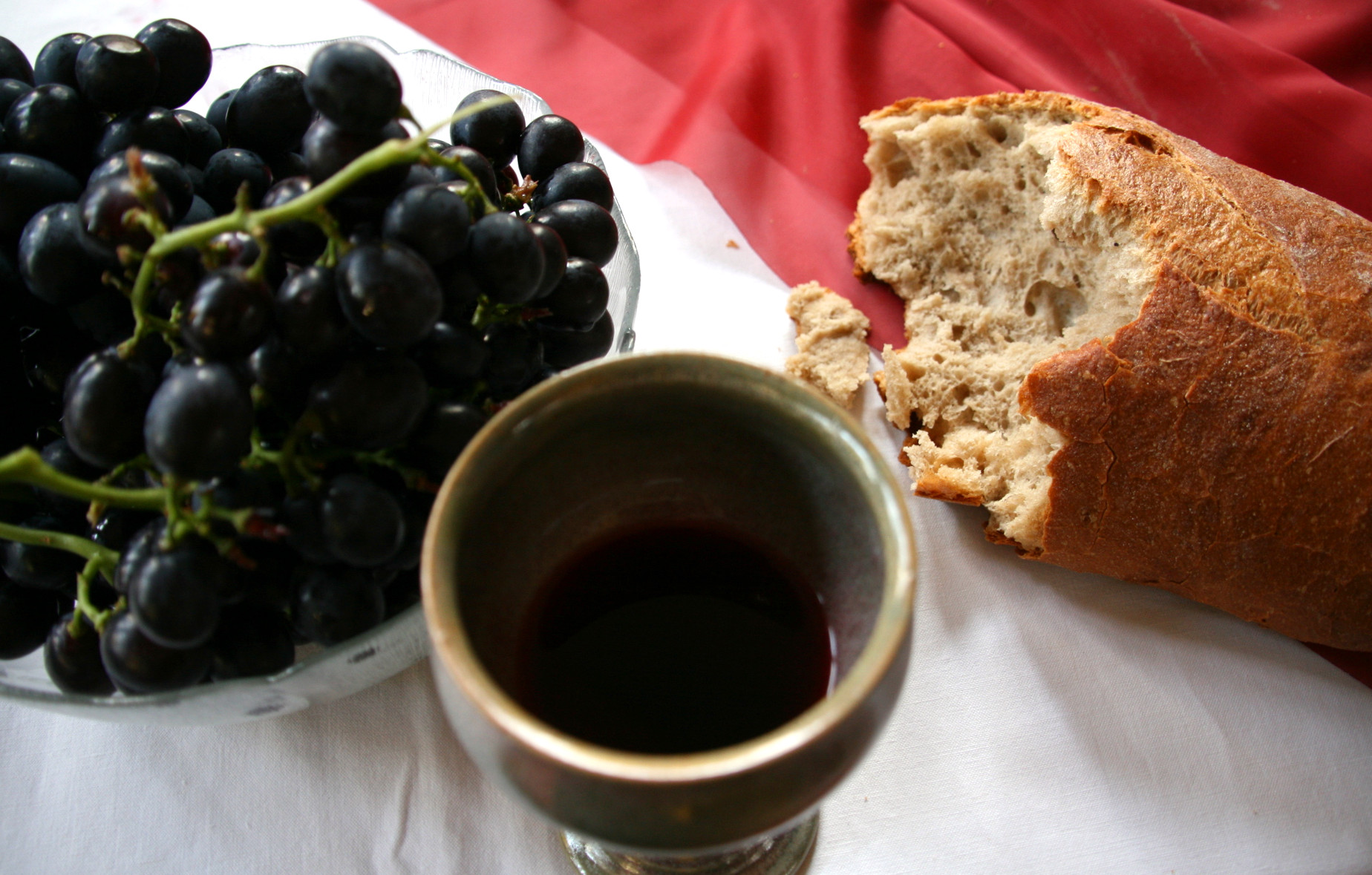
"Let all, therefore, who truly desire the grace of God, eat of that bread, and drink of that cup."

[This is a post on one of John Wesley's Sermons as part of the Getting to Know John series. See the other posts here.]

Because the Lord's Supper is so central to Wesleyan and early Methodist spirituality, it's appropriate that posting on this sermon falls today, on Maundy Thursday, when we remember Jesus' last supper with his disciples and the beginning of the Christian church's sacrament of Holy Communion. If there is any day when we should practice a combination of all three of the means of grace Wesley focuses on in this sermon (prayer, searching the Scriptures, and receiving the Lord's Supper), we should do so today.

This is a great sermon, and it is key to understanding John Wesley and the meaning of Methodism. Practicing the means of grace (or, in his language, "attending upon all the ordinances of God") was one of the three General Rules that made up the lifestyle that the early Methodists agreed to live by. Doing what Wesley describes in this sermon, combined with commitments to do good for others and avoid doing any harm were what it meant to be a Methodist in Wesley's day (as well as participation in Methodist groups), and they still form a reliable framework for how we can shape our lives today.

I wish that the sermon described more of what grace meant for Wesley, but apparently its definition was known well enough by his audience that there was no need to include a description. The need is tremendous in our day, though, because its meaning has been reduced drastically between his time and ours. Today, we often equate God's grace with his willingness to forgive our sins. That certainly is gracious of God, but his grace is much bigger than that. When grace is only forgiveness, the very phrase, "means of grace" makes no sense. How can doing these things be a means of God's forgiveness? That is far from the intended meaning.

Dallas Willard says that grace is God's action in our lives to bring about what we do not deserve and cannot accomplish on our own. That's a much bigger (much more Wesleyan and much more Biblical) understanding of grace. When we understand it in this way, we can see how prayer, "searching the Scripture," and receiving the Lord's Supper are essential ways that we open doors in our lives to God's work in us.

Wesley spends much of the sermon addressing the theologies of his day which questioned whether outward things that we do have any role in the Christian life. Although the questions would be phrased differently today, they're still very applicable. Is doing these things necessary for Christians? Wesley lays the groundwork for an unequivocal "Yes" which is utterly dependent on God's grace.

If you consider yourself a Methodist, or if you may already be one and don't know it, you will do well to dig in to this sermon.

You can download my ePub file of the sermon to read on electronic devices, read the entire text online, or just review my outline of the sermon.

A Wesleyan Hymn for today and for this sermon:

Because Thou Hast Said Charles Wesley, 1748

1. Because thou hast said: "Do this for my sake," the mystical bread we gladly partake; we thirst for the Spirit that flows from above, and long to inherit thy fullness of love.

2. 'Tis here we look up and grasp at thy mind, 'tis here that we hope thine image to find; the means of bestowing thy gifts we embrace; but all things are owing to Jesus' grace.


A Prayer for Holy (Maundy) Thursday

"O God, by the example of your Son, our Savior Jesus Christ,you taught us the greatness of true humility, and call us to watch with him in his passion. Give us grace to serve one another in all lowliness, and to enter into the fellowship of his suffering; in his name and for his sake. Amen."

- By W.E. Orchard, from The United Methodist Book of Worship

A Prayer for Wednesday of Holy Week

"Most merciful God,your blessed Son, our Savior, was betrayed, whipped, and his face spat upon. Grant us grace to endure the sufferings of the present time, to overcome all that seeks to overwhelm us, confident of the glory that shall yet be revealed; through Jesus Christ our Redeemer. Amen."

-From The Book of Common Prayer