
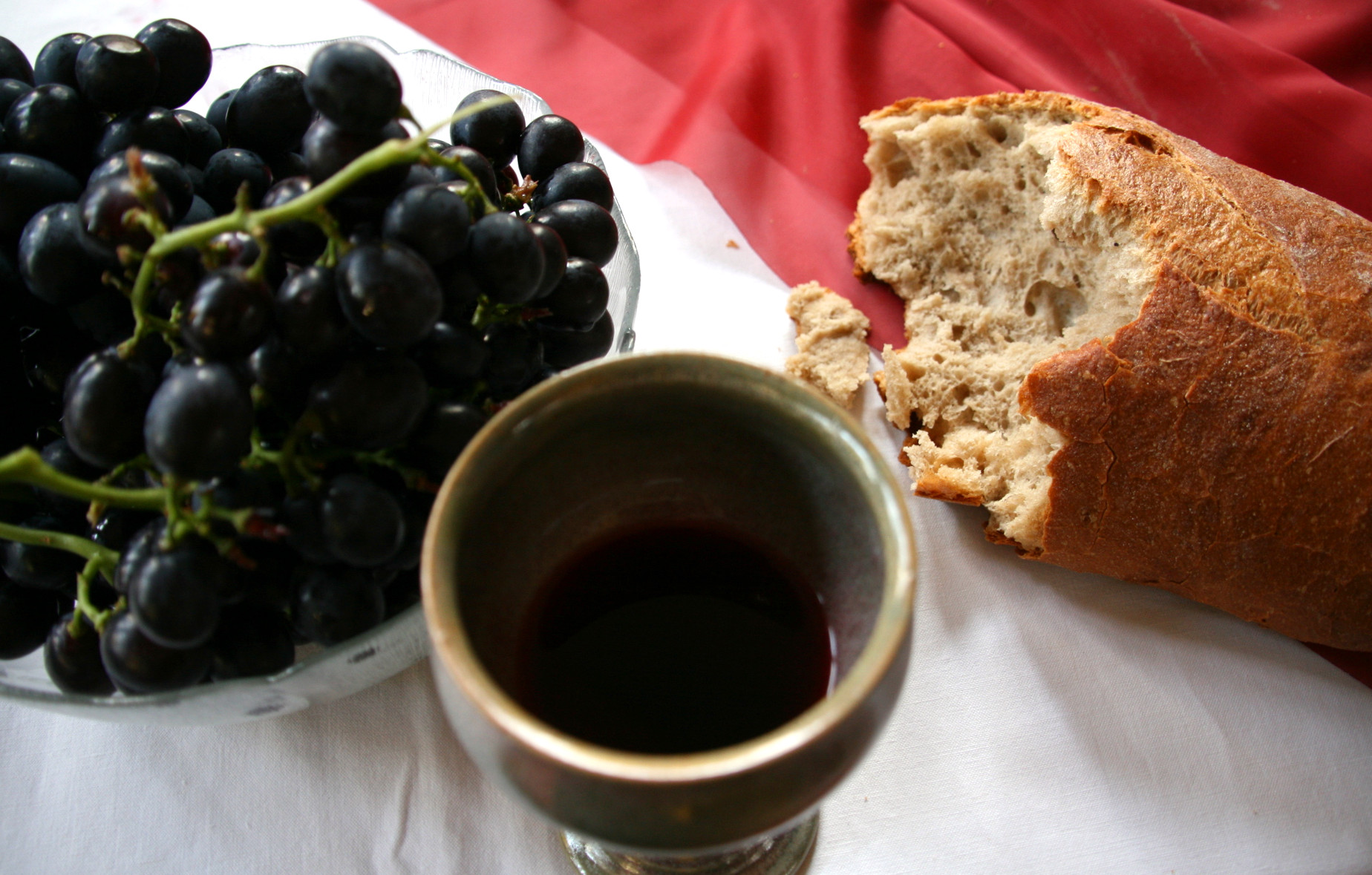
Wesley's Sermon 16: The Means of Grace

"Let all, therefore, who truly desire the grace of God, eat of that bread, and drink of that cup."

[This is a post on one of John Wesley's Sermons as part of the Getting to Know John series. See the other posts here.]

Because the Lord's Supper is so central to Wesleyan and early Methodist spirituality, it's appropriate that posting on this sermon falls today, on Maundy Thursday, when we remember Jesus' last supper with his disciples and the beginning of the Christian church's sacrament of Holy Communion. If there is any day when we should practice a combination of all three of the means of grace Wesley focuses on in this sermon (prayer, searching the Scriptures, and receiving the Lord's Supper), we should do so today.

This is a great sermon, and it is key to understanding John Wesley and the meaning of Methodism. Practicing the means of grace (or, in his language, "attending upon all the ordinances of God") was one of the three General Rules that made up the lifestyle that the early Methodists agreed to live by. Doing what Wesley describes in this sermon, combined with commitments to do good for others and avoid doing any harm were what it meant to be a Methodist in Wesley's day (as well as participation in Methodist groups), and they still form a reliable framework for how we can shape our lives today.

I wish that the sermon described more of what grace meant for Wesley, but apparently its definition was known well enough by his audience that there was no need to include a description. The need is tremendous in our day, though, because its meaning has been reduced drastically between his time and ours. Today, we often equate God's grace with his willingness to forgive our sins. That certainly is gracious of God, but his grace is much bigger than that. When grace is only forgiveness, the very phrase, "means of grace" makes no sense. How can doing these things be a means of God's forgiveness? That is far from the intended meaning.

Dallas Willard says that grace is God's action in our lives to bring about what we do not deserve and cannot accomplish on our own. That's a much bigger (much more Wesleyan and much more Biblical) understanding of grace. When we understand it in this way, we can see how prayer, "searching the Scripture," and receiving the Lord's Supper are essential ways that we open doors in our lives to God's work in us.

Wesley spends much of the sermon addressing the theologies of his day which questioned whether outward things that we do have any role in the Christian life. Although the questions would be phrased differently today, they're still very applicable. Is doing these things necessary for Christians? Wesley lays the groundwork for an unequivocal "Yes" which is utterly dependent on God's grace.

If you consider yourself a Methodist, or if you may already be one and don't know it, you will do well to dig in to this sermon.

You can download my ePub file of the sermon to read on electronic devices, read the entire text online, or just review my outline of the sermon.

A Wesleyan Hymn for today and for this sermon:

Because Thou Hast Said Charles Wesley, 1748

1. Because thou hast said: "Do this for my sake," the mystical bread we gladly partake; we thirst for the Spirit that flows from above, and long to inherit thy fullness of love.

2. 'Tis here we look up and grasp at thy mind, 'tis here that we hope thine image to find; the means of bestowing thy gifts we embrace; but all things are owing to Jesus' grace.


A Prayer for Wednesday of Holy Week

"Most merciful God,your blessed Son, our Savior, was betrayed, whipped, and his face spat upon. Grant us grace to endure the sufferings of the present time, to overcome all that seeks to overwhelm us, confident of the glory that shall yet be revealed; through Jesus Christ our Redeemer. Amen."

-From The Book of Common Prayer

Golf Skills, Spiritual Formation, and My Deficiency in Both

I played golf with my father-in-law last week. It was the third time I've played in my life, and the first time in fifteen years. My first two experiences were miserable. At that point in my life, I was still pretty proud of my self-perceived athletic ability (since I had yet to experience the forced humility that my lack of success in college basketball would bring), and those first encounters with a game at which I was totally inept were extremely frustrating.

Last week's experience certainly doesn't qualify as miserable, but a huge gap remains between how much I think I might enjoy golf and how much joy I actually get from the experience of it. When I see pictures of golf courses, I can easily catch myself thinking that I should be very into this sport. I love being outside, and golf courses are very nice places to be. It's a game that appears to go at a relaxed pace, and at this point in my life I'm much more drawn to sports that are popular with the geriatric population than I am to those that involve constant running and jumping. So I was genuinely looking forward to it when my father-in-law invited me to play. But why don't I enjoy that sport more?

The answer is simple: I stink at golf. I wasn't surprised by the number of balls that went flying in a direction more than 60 degrees away from where I intended them to go, nor by the number of putts that missed by at least 15 feet, nor by how many towering drives of 60-80 yards I was able to crush. No, what surprised me most was how many times I completely  missed the ball. I never thought about a "swing-and-a-miss" as a possibility in golf, but it is. Apparently even making contact with the ball requires some degree of skill which I have yet to really develop.

If you're a golfer, you don't want to play with me. I don't have my own clubs, so I'll have to borrow yours, but I'm likely to lose one of them on the course. (Don't worry, Barry, I realized I'd left your 7 on the previous green and went back to get it.) I don't have any golf balls, so will have to use some of yours and will definitely lose some of them. (Rather than keeping my score, I eventually began judging my success by whether or not I lost a ball on each hole.) But on the other hand, if you're okay with the material loss involved with playing with me, the positive thing is that it will provide a boost to your confidence, because you will look really good with me as your partner.

Thankfully, some redemption of the experience came when I began to notice some parallels between my golf experience and spiritual formation:

  1. It's incorrect to say that I have no golf skills; the more accurate statement is that the golf skills I have are very poor. You have some golf skills too- it's just a question of whether they are good or bad. This is the same with our spiritual formation, because spiritual formation in itself is neither positive nor negative, but just a reality of human existence. We are all in the process of becoming one kind of person or another. The question is more about whether the spiritual formation we have received and are choosing is good (spiritual transformation) or bad (spiritual malformation).

    It's understandable that every month and year that passes without playing any golf, my already poor golf skills become worse. My body practices doing other things than swinging those clubs. The same is true with our spiritual lives, because it is never the case that we stay the exact same kind of person that we were yesterday. We make decisions each day that shape us (form us), either into a more spiritually transformed person or a more spiritually malformed person. We will be well off to recognize this, pay attention to it, and plan accordingly.

  2. While I was on the golf course last week, my main insight was the incredible amount of work it would take to become proficient at that sport, and how I have invested none of it. Being a good golfer (not necessarily measured by my competition against others, but more by the degree to which parts of the game become easy, natural, and enjoyable) would require a lot of practice. Somehow, though, in the spiritual life, we hear Jesus say something which is Christianity's equivalent of Jack Nicklaus-type skills, like "bless those who persecute you," and think that we should be able to do them as beginners and from then on whenever we want.

    But it doesn't take long to realize that life doesn't work that way. Throwing an emphatic "In Jesus' Name!" onto our request to God to give us patience, humility, joy, or peace does not bring the result we desired. No, the Christian life also requires a lot of practice. However, if I practice well, I will eventually become good at the things Jesus taught us to do. Again, my proficiency at them is not measured in a competitive way against others, but rather in terms of how I handle the things of life that come at me. The best students of the way of Jesus through the centuries attest to the experience of parts of life becoming easy, natural, and enjoyable, which apart from his way were only frustration. It was, after all, the Teacher (who would later be crucified and rise from the dead) who told us that in learning to live his way, we would find rest for our souls, because his yoke is easy and his burden is light.

  3. The practice pays off. My father-in-law said that one of his favorite things about golf is that, regardless of how you may play the other 17 holes, there's always the possibility that you'll play this hole better than Tiger Woods, or any of the best players in the world. (It was after he said this that I discovered how this statement assumed I at least had the level of skill required to actually make contact with the ball.) But for someone who practices, he's exactly right.

    And no matter how much I make mistakes in my pursuit of God and his kind of life in this world, there's always the possibility that as I practice living his way and opening myself to his grace day after day, that I will be able to genuinely act like Jesus in this situation that comes my way today. Everything adds up, and the practice pays off.

I will not practice golf today, nor probably any other day until my father-in-law invites me to play again. And, as a result, when we do play I will still be a very poor golfer. But in the meantime, I will continue to practice living Jesus' way, so that the next time I'm on a golf course I will hopefully have much more of an awareness of God's presence while enjoying the time outdoors and much less of a desire to shatter my friend's clubs into pieces in Jesus' name!

A Prayer for Tuesday of Holy Week

"Holy and compassionate God, your dear Son went not up to joy before he suffered pain,and entered not into glory before he was crucified. Mercifully grant that we, walking in the way of the cross, may find it the way of life and peace; through Jesus Christ your Son, our Savior. Amen."

- From The Book of Common Prayer

A Map for Navigating Holy Week

As we jump into Holy Week, here are some options to guide your reflection on Scripture, one for using printed Scriptures and another is for listening and reflecting audibly. I'll also note opportunities to participate in prayer and worship with communities of people both in your area and around the globe. Do all of these, or none of them, but especially during this week, do something! Everything I'll list here will be reliable, so choose whatever draws your attention.

Option 1: Reading Through the Week

The first option is to use the passages from the Revised Common Lectionary to guide your reading this week. Normally the lectionary only gives passages for Sundays, but during Holy Week and some other special days of the Christian year, it also provides readings on some weekdays. While most of its readings rotate through a three-year cycle, the readings for Monday - Friday of this week are the same every year.

Monday of Holy Week

  • Isaiah 42:1-9: The first of four "Servant Songs" of Isaiah, all of which are included in the readings during this week. These songs both point forward to an individual (the Messiah), and describe Israel at its best. This passage describes the Messiah as one who "will not shout or cry out... a bruised reed he will not break, and a smoldering wick he will not snuff out" until he brings forth justice on earth.
  • Psalm 36:5-11: Praise to God for his love, faithfulness, righteousness, and justice.
  • Hebrews 9:11-15: How Christ's blood on the cross was superior to the blood of temple sacrifices, establishing a new covenant, so that we could be set free from sin.
  • John 12:1-11: To begin the week leading up to his crucifixion, Jesus visits the home of his friends Mary, Martha, and Lazarus for the final time. At a dinner given in Jesus' honor, Mary enters and pours expensive perfume on Jesus, drying his feet with her hair.

Tuesday of Holy Week

  • Isaiah 49:1-7: Isaiah's second Servant Song, expressing that although the Messiah would be sent to bring Israel back to God, he would also be made a light for the Gentiles, so that he could "bring [God's] salvation to the ends of the earth."
  • Psalm 71:1-14: A plea to God for deliverance from the hands of the wicked. Although others will say, "God has forsaken him," the Psalmist pleads, "Be not far from me, O God; come quickly, O my God, to help me."
  • 1 Corinthians 1:18-31: "The message of the cross is foolishness to those who are perishing, but to us who are being saved, it is the power of God..."
  • John 12:20-36: Jesus predicts his death, saying that "the hour has come for the Son of Man to be glorified," and "unless a kernel of wheat falls to the ground and dies, it remains only a single seed. But if it dies, it produces many seeds."

Wednesday of Holy Week

  • Isaiah 50:4-9a: The third Servant Song of Isaiah: "I have offered my back to those who beat me, my cheeks to those who pulled out my beard... I have set my face like flint... It is the sovereign Lord who helps me."
  • Psalm 70: A plea to God for help when faced with the threats of enemies. Contains the words so often repeated in traditional prayers: "Hasten, O God, to save me; O Lord, come quickly to help me."
  • Hebrews 12:1-3: An admonition to throw off the sin that entangles us so easily and remain focused on Jesus, "who for the joy set before him endured the cross, scorning its shame..."
  • John 13:21-32: Jesus predicts his betrayal and tells Judas, "What you are about to do, do quickly."

Holy (Maundy) Thursday

  • Exodus 12:1-4, (5-10), 11-14: God's instructions to Moses on how the Israelites were to celebrate the Passover, which is what Jesus and his disciples were doing on this evening.
  • Psalm 116:1-4, 12-19: A psalm thanking God for deliverance from death. "How can I repay the Lord for all his goodness to me? I will lift up the cup of salvation and call on the name of the Lord."
  • 1 Corinthians 11:23-26: Paul recounts what he received from the Lord regarding the Lord's Supper.
  • John 13:1-17, 31b-35: Jesus washes the disciples' feet and gives them his new command: "As I have loved you, so you must love one another."

Good Friday

  • Isaiah 52:13-53:12: Isaiah's fourth, final, and climactic Servant Song. This passage is quoted more frequently in the New Testament than any other Old Testament passage. "He was pierced for our transgressions, he was crushed for our iniquities, the punishment that brought us peace was upon him, and by his wounds we are healed."
  • Psalm 22: The psalm quoted by Jesus from the cross: "My God, my God, why have you forsaken me?"
  • Hebrews 10:16-25: Because of Jesus' faithfulness and sacrifice, God's law can be written in our hearts and minds and our sins remembered no more. Now a new way has been opened for us to draw near to God.
  • John 18:1-19:42: John's full account of Jesus' arrest, trial, crucifixion and death and Peter's denial.

Option 2: Listen and Pray Through the Week

A friend recently introduced me to a podcast I've been enjoying greatly, which is based on the Christian year and features prayer, music, a Scripture passage and reflection for each day. It's produced by a group of British Jesuits, which provides a couple of benefits: it's very helpful in leading us to engage the day's passage of Scripture rather than just hear it and move on, and second, the British accents make the narrators sound much more intelligent and spiritual than I would in my Texas drawl.

The podcast and website are called Pray as You Go, and you can get the recordings through their website or their iTunes feed.

Option 3: Pray With a Worldwide Community on Good Friday

My friends at The Transforming Center, led by Ruth Haley Barton, are offering everyone a resource to guide your time of prayer wherever you are on the afternoon of Good Friday. I know their resources well enough to know that this will be well done, and it will provide us a way to pray together as a community regardless of where we are. Click here to read their blog post and receive their prayer guide.

Option 4: (Please do this one!) Worship and Pray with a Church in Your Community

It's always wonderful to see how many people are in worship on Easter Sunday morning, and our community celebrations of Easter will certainly be richer if we have also joined together to worship and pray on Maundy Thursday and/or Good Friday. Hopefully your church has an option on one or both of these days for you to participate in. If not, feel free to participate as a guest in a church that does. If you are in the Midland/Odessa area, join our church as we gather for a Maundy Thursday and Tenebrae service at 6:30 Thursday evening at First United Methodist Church of Midland. (Feel free to leave what your church is doing as a comment below to let others in your area know.)

Welcome to Holy Week

Even if someone is not a Christian, an honest analysis of the way that history has played out over the last 2,000 years would have to point to the events that Christians remember during the coming week as the most significant events in history. What else has shaped people and culture in such a dramatic way as the execution and resurrection of this first-century Jew from Nazareth named Jesus? (And if someone does not believe in the possibility of his resurrection, what possible course could history have taken to bring a poor Jew from an obscure place to still have such influence in our world today?) As we enter into this week, beginning today, Palm Sunday, with our remembrance of Jesus' entry into Jerusalem on a donkey, I have found it helpful to try to put all of the stories about Holy Week into a day-by-day context. Although we may be familiar with many of all of these stories, we often do not think about them in the context of this final week of Jesus' life, which certainly intensifies their meaning.

This is far from scientific; particularly on Monday-Wedensday, we cannot know for sure which events happened on which days, but the order of the outline below is very possible. Most of the passages below are from Matthew's account, since during this year the Revised Common Lectionary has us spending most of our time in his gospel. (Beginning tomorrow I'll post a suggested way of reading scripture this week based on the lectionary.) There are a few key events in the other gospels which Matthew does not include, so they are also listed below.

A couple of things to note: You can download full outline of the events of Holy Week in all four gospels by clicking here. Feel free to use it for your own study. Also, I got a lot of help from the NIV Study Bible's chart called "Passion Week."

Sunday:

Monday:

Tuesday:

Wednesday:

Thursday:

Friday:

Saturday: Jesus is Dead in the Tomb

Then we wait for Sunday.