A Prayer for the Twenty-Fourth Sunday of Ordinary Time (Year A)

[This is one of a series of Prayers for the Christian Year. To see the other posts, click here.]

Living, loving Father,

Who else is there like You? You alone are majestic in holiness, awesome in splendor, doing wonders. You are our strength. You are our might. You have delivered us from the captivity of sin and death to the freedom of life and salvation, and therefore we will always praise You.

Just as You have loved us and done everything needed for our deliverance, You have also done so for everyone we meet. So help us, Father, to see everyone around us not as people who can serve us and our desires, but as those who can serve You just as we are doing; not as people whom we need to correct in order to get our way, but as Your children whom you love just as You love us, remembering that we all alike will stand before You, bow our knees, and praise You with our tongues, because of how good, generous, and merciful You have been to each one of us.

We have seen this mercy most clearly in Your Son, Jesus. It was he who taught and showed us that forgiveness is possible regardless of the wrongs done to us, because, in truth, we all are indebted to You infinitely beyond our ability to repay. Help us to see the extent to which You have been merciful to us so that we may be merciful to others and so grow in the character of our Lord Jesus, who taught us to pray, saying,

Our Father in heaven, hallowed be Your name, Your kingdom come, Your will be done,  on earth as in heaven.

Give us today our daily bread.

Forgive us our sins as we forgive those who sin against us.

Save us from the time of trial and deliver us from evil.

For the kingdom, the power, and the glory are Yours now and for ever. Amen

Notes:

Depending on which system of ordering one pays attention to, this Sunday can also be referred to as Proper 19, or (in 2011) the Thirteenth Sunday after Pentecost. Regardless of the system, the readings are the same. So, the readings for this week, on which this prayer is based, are:

  • Exodus 14:19-31: The fourth of nine consecutive readings from Exodus. This passage is the dramatic exit (exodus) of God's people from captivity in Egypt as they walk through the Red Sea on dry ground.
  • Exodus 15:1b-11, 20-21: A song of worship from Moses, the Israelites, and Miriam in praise of God's salvation, recognizing that it is God alone who has saved them from captivity.
  • Romans 14:1-12: The fifteenth of sixteen possible consecutive readings after Pentecost from Romans. In this passage, Paul gives practical instructions on how to deal with differences among Christians regarding beliefs about how they should live, emphasizing that all of us will be accountable to God for how we live and that we do not need to take on the immense responsibility of passing judgment on others.
  • Matthew 18:21-35: All of the gospel readings after Pentecost in Year A come from Matthew. This passage contains Jesus' parable of the servant who, having been forgiven a tremendous debt by his master, then refused to forgive a coworker's small debt. Jesus told this in response to Peter's question of how many times to forgive one of his brothers, "As many as seven times?... Not seven times, but I tell you, seventy-seven times." In other words, give up keeping count. Be merciful to others, for we have always been given much more mercy than we are asked to give.

Top Posts for August 2011

Three Birthdays

Three birthdays (of sorts) have taken place recently in our house. In reverse order of importance:

  • Due to my lack of consistency in posting on this blog over the past couple of months, I missed the fact that the blog turned a year old on August 1. In the big scheme of things, this is not a big birthday. But I've really enjoyed this project over the past year, and it has been a hugely important year in the life of our family, so even if it's almost a month and a half late, I'll still throw a small inner celebration in SalvationLife's honor.
  • MUCH more important: my son turned three last week.
  • And my son would never have been turning three if my wife hadn't married me ten years ago last week. Yes, this is usually called an anniversary, but it's late and I'm trying to string a blog post together for the sake of getting something up.
I've got more to say about every one of these, but for now, a few thoughts on each of them in actual order of importance:
Being married to my wonderful, beautiful wife for 10 years is a big deal. It's really hard to believe it's been a decade. A lot of life has happened in these ten years together:
  • We've lived in three different places (Georgia, Guatemala, and Texas),
  • each begun and finished graduate school,
  • made lots of new friends along the way and said goodbye to quite a few as well,
  • lost people whom we loved dearly (including Chepe, four grandparents, a baby we never knew, and my Dad),
  • been overjoyed by welcoming a son and a daughter into the world,
  • and really enjoyed living our lives together through all of it.
I may not ever be accused of being an overachiever in anything related to my work, but I seriously overachieved in marrying the girl I did. If there's ever a "How in the world did he get her?!?" Hall of Fame, I'll be a first-ballot inductee.

Our son's third birthday was a big day for all of us. It's the first year that he was really able to anticipate it, and we all really enjoyed the day. Last year on his birthday, we caught ourselves sometimes being too busy with preparations for celebrating his birthday to actually enjoy doing things with him. "Sorry, buddy, I can't play with you right now because there's too much to do to celebrate the fact that you're alive" didn't seem like much of a way to help a toddler know how much he's loved. So, we were more intentional about taking time with him this year, and it was a good day for all of us.

One thing that surprised me on his birthday was how much I missed my Dad. I still never know what's going to hit me and what won't. I missed my Dad on his own birthday and Father's Day, but neither of them really got to me. Yet two of the days his absence has hit me the hardest have been my kids' birthdays. He loved his grandkids, and I would have loved seeing him with them.

And then the blog's birthday... Not too much to say about it, but because I'm a statistics nerd, I was curious to see which posts have been read the most since the blog's launch on 8/1/10:

  1. One Day Closer to Rain
  2. Big Changes in My Work Roles
  3. My Little Girl
  4. If You Really Knew Me, You Would Know My Father As Well
  5. Something Blogging and Marriage Have in Common
  6. Wesley's Sermon 16: The Means of Grace
  7. A Prayer for Trinity Sunday (Year A)
  8. A Prayer for Ascension Sunday (Years A,B,C)
  9. Completely Unhelpful Thoughts I've Shared With My Son
  10. How to Not Get Kicked Out of My Parents' House

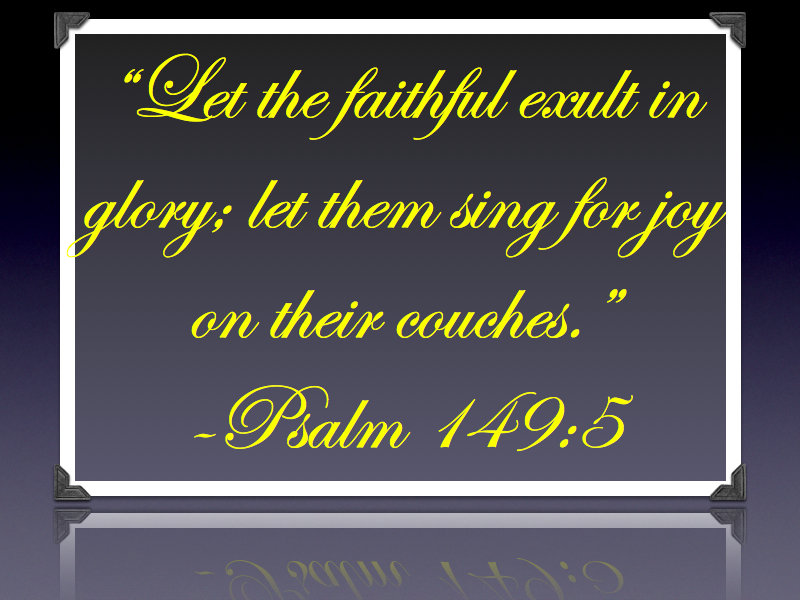
Scripture Plaques You Won't Find at the Christian Bookstore, #12

[This post is one of a series of potential Christian plaques that we would never find at a Christian bookstore. See the rest of the list here.]

Many of us will find this to be really good news with college football season beginning next week.

Psalm 149.5.001

I previously never thought the word "couch" was in the Bible. To my surprise, it shows up 17 times in the NRSV. So I know the place I will start working on making my life more Biblical...

5350_2918

Sabbath's Good Slow Work in Us

In our family, we are Sabbath novices, but we've come to love the small tastes of it that we've experienced so far. We had been out of the rhythm of a weekly Sabbath for a while in the weeks right before and after our daughter's birth, but life is now getting a bit closer to having normalcy again, so we've enjoyed jumping back in to our experiments with Sabbath.

Last week, we had begun our Sabbath together as we normally do with supper and unplugging ourselves from email, text messages, etc. And since it was one of the two nights each week when we're allowed to water our grass in the local drought-time water restrictions, I went out into our yard after supper to get our sprinklers running. (Some of you from other parts of the country will have no concept of this. You always have green grass without working for it. The tradeoff is that while your yard could stand to be mown every 5 days or so, I've only mowed twice this whole year.)

As I went out to set up the sprinklers, my son wanted to tag along as he often does. So he played while I got things going. Then, after a bit my wife also came out with our baby girl and they rocked on our porch swing. It was a good, slow evening of pushing my son in his new swing set while knowing that there wasn't anything else that I needed to be accomplishing on that night.

Eventually I went over to sit with my wife and baby on the swing. (Thankfully, the yard is big enough for the sprinklers to be running and not getting us wet while we're doing these things.) As I walked over, I could see his eyes looking at the sprinklers, with an idea brewing in his two-year-old mind. I told him, "Bud, go ahead and run through them if you want to." He got close enough to get a little wet, but wasn't very sure what else to do.

I sat down on the swing next to my wife while he stood there getting a little wet. He asked me to come play in the sprinklers with him, and although I was in a good, slow Sabbath mode, it hadn't progressed far enough to let me lower my resistance to getting soaked in my clothes, and I declined the invitation.

About a minute later, my wife said, "Oh, why not?," handed me the baby and went to give our boy a lesson by example in how to get thoroghly soaked by your back yard sprinklers.

They were both laughing as hard as I've ever seen them, and it continued for a while. The longer it went on the sillier they got, with our son eventually losing himself in belly laughs while my wife carried him around encouraging him to shake hands with the leaves on our tree as the sprinkler continued to soak them. I enjoyed watching their fun as much as they enjoyed having it.

There are seven days each week, but we're finding that stuff this good is much more likely to happen during one of them when we're in the rhythm of practicing the Sabbath.

It's a 24-hour period when we set the boundaries around ourselves to entrust whatever hasn't been accomplished into God's hands. This reminds us that regardless of how hard we work during the other six days, our work is really only a very small piece of all of the good that God is working to accomplish in our world; his kingdom actually survives just fine even when we lay the striving aside for a day.

It's a 24-hour period when loving and enjoying each other are among the highest priorities on the things we have to do. All of the emails that need our responses, all of the blog posts there are to write, and the myriad of other things get laid aside once each week. And we're falling in love with it.

P.S.: If you're curious, or looking for a way to become Sabbath novices in your house too, Ruth Haley Barton's chapter on Sabbath in her book, Sacred Rhythms, was one of the main things that opened the door for us.

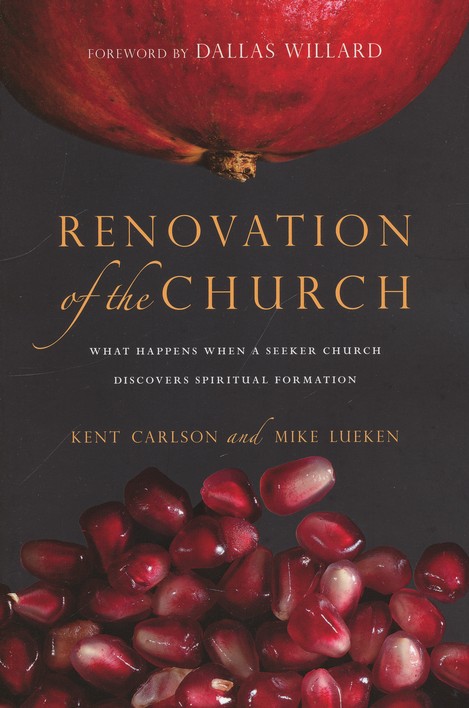
Book Review: Renovation of the Church by Kent Carlson and Mike Lueken

This is a book I have been waiting for someone to write for a very long time. When I was preparing for my senior year of college, I was required to spend a summer doing a ministry internship. Although I'm thankful that I had the opportunity to do that as part of a good ministry in a good church, that summer left me disillusioned with ministry. I returned to my senior year at Asbury hungry for a way of doing ministry that led to something more, and that hunger, along with relationships I was fortunate to have with great people at Asbury, guided me into the beginning of my interest in spiritual formation. It was during that year that I first read Dallas Willard, and from then on, my understanding of Christianity and ministry was dramatically changed.

The authors of [amazon_link id="0830835466" target="_blank" ]Renovation of the Church[/amazon_link] had very similar experiences, only theirs occurred more than a decade into a very successful attempt at planting a church. They had a rapidly growing suburban church with a new facility, and had around 1,700 people attending worship every weekend. Then they realized that the way they did ministry was actually working against the likelihood that their followers would ever have their characters become significantly like that of Jesus. They state, "It slowly began to dawn on us that our method of attracting people was forming them in ways contrary to the way of Christ" (35).

The book tells the story of their church, Oak Hills Church of Folsom, CA, from the time that it was planted, through their entry into the seeker church movement and rapid growth, then through the decision to change and the mistakes, consequences, and rewards that have followed. It is very honest, respectful, and obviously took a great deal of courage to publish. (Congratulations to both the authors and InterVarsity Press for doing so.) I've read the stories of other pastors or churches who have gone through similar journeys, but this is by far the best written.

Dallas Willard's foreword is worth the price of the book. He opens the book with a question (also repeated in a later chapter) which the rest of the book tries to unpack and Willard says is "the single most important question in the church culture of North America today": "How do we present the radical message of Christ in a church that has catered to the religious demands of the nominally committed?" (9) Or, as it played out in the story of Oak Hills, the question might be: How can we expect people whom we have attracted with a 'come have all of your preferences and desires met at church' style of ministry to respond well to Jesus' 'deny yourself and give up your life to follow me' gospel? The authors concluded that those two were incompatible.

Personally, one of the greatest strengths of the book was in making connections I had not been able to make before between our consumeristic habits that are so deeply ingrained in us in North American culture and churches' general lack of effectiveness at helping people grow in the character of Christ. As the authors point out, cultural consumerism isn't so much the problem, as is how churches have adopted the consumerism of the culture around us and decided we have to harness it as a strategy for church growth. Ministry becomes an endless cycle of creating attractive ministries to get people to come to our churches, then trying to keep them happy and engaged enough to continue coming rather than dropping out or finding another church. When people come to us on these terms, we cannot be surprised when we discover that they may actually have very little interest in learning to do the things that Jesus taught and arranging their lives as any of his serious students would naturally do.

Along with tackling the "insidious monster" of consumerism, the book also addresses personal ambition in pastors and how it feeds this destructive cycle. We can cover and excuse our selfish ambition in language of wanting to accomplish great things for God's kingdom, but ambition often leads us into ways of living that are destructive to our souls and those of the people following us. As Carlson states,

"The desire to be better than others, the odious nature of comparison, and the lack of contentment with our actual state, is the problem formationally. This whole personal ambition thing is a very messy area... Perhaps ambition is needed more than ever. But it must be ambition directed toward something other than personal and organizational success. We must be ambitious to decrease so that Christ may increase. This is truly something worth giving our lives to " (76, 87).

Amen. Our churches will certainly benefit if this book can launch honest conversations among our leaders.

P.S.: If you're not a pastor, this is still an important book to read, but... If you come away from reading it ticked off at your pastor or your church for not doing things this way, you've entirely misread the book. The authors themselves strongly urge against thinking that would lead to such a reaction, as they state that the best possible result is for you to encounter God in the church where you already are, rather than going looking for another church or pastor who does things the way you like. As I've stated it before personally, the biggest hurdle to great ministry in my church is my own unlikeness to Jesus, not that anyone else has gotten things wrong. In almost every case pastors and church leaders are working very hard and doing the very best they can in an incredibly difficult job. Take it easy on them, and use this book to help you become more like Jesus for them.

Disclosure of Material Connection: If you purchase resources linked to from this blog, I may receive an “affiliate commission.” I am disclosing this in accordance with the Federal Trade Commission’s 16 CFR, Part 255: “Guides Concerning the Use of Endorsements and Testimonials in Advertising.”

Regardless of whether I receive a commission, I only recommend products or services I use personally and believe will be good for my readers.

A Prayer for the Twenty-Second Sunday of Ordinary Time (Year A)

[This is one of a series of Prayers for the Christian Year. To see the other posts, click here.] Living, loving Father,

We give You thanks today as we call upon Your name. You have done so much for us, and for all who have gone before us, that it is our joy to sing Your songs and tell Your stories, so that we will always remember Your faithfulness.

Although we do not understand why, You have issued a call to each one of us, to know You, follow You, and play a part in Your work in the world. On our own, we are incapable and still stuck in bondage, yet as we open our eyes to Your presence and listen to Your call, You promise to be with us as we go about Your work. May we all know the desperation of having things to do for You that are much too big for our own powers.

As we follow along in Your ways, we will realize that whether or not Your call to us involves things that appear to be big, following You always reveals parts of us that need Your healing touch, and these things are always the core of Your work in our world. Teach us to let love be the center of who we are, loving You and others deeply, learning, as was the way of our Master, Jesus, to bless those who seek to do us harm.

It is from the matchless example of the life that He lived among us as Your Son that we best learn how to love, how to keep our minds on Your things rather than on the ways of the world around us, and how it is in giving up our own lives that we find real life.

So it is again today, as His students, who have heard His call to deny ourselves, take up our cross and follow Him, that we take the step of praying the prayer that He taught us, saying,

Our Father in heaven, hallowed be Your name, Your kingdom come, Your will be done,  on earth as in heaven.

Give us today our daily bread.

Forgive us our sins as we forgive those who sin against us.

Save us from the time of trial and deliver us from evil.

For the kingdom, the power, and the glory are Yours now and for ever. Amen

Notes:

Depending on which system of ordering one pays attention to, this Sunday can also be referred to as Proper 17, or (in 2011) the Eleventh Sunday after Pentecost. Regardless of the system, the readings are the same. So, the readings for this week, on which this prayer is based, are:

  • Exodus 3:1-15: The second of nine consecutive readings from Exodus. This is God's call to Moses from the burning bush, including Moses' initial objection to the call and God's assurance that he would go with Moses to deliver his people from Egypt.
  • Psalm 105:1-6, 23-26, 45b: Part of a hymn that recounts God's work to save his people from the time of Abraham until they settled in Canaan. These verses of the Psalm call the reader to worship God for his deeds among the people, how Jacob's descendants multiplied and were oppressed in Egypt, and that God sent his servant Moses to free them.
  • Romans 12:9-21: The thirteenth of sixteen possible consecutive readings after Pentecost from Romans. This passage is a list of instructions from Paul on living in the way of Christ, centering on the command to live genuinely loving lives.
  • Matthew 16:21-28: All of the gospel readings after Pentecost in Year A come from Matthew. This passage is the beginning of how "from that time on" Jesus prepared his disciples for his death. Peter objects to what Jesus says, receives a strong rebuke from Jesus ("Get behind me, Satan..."), and Jesus gives the call most often repeated in the gospels: "If any want to become my followers, let them deny themselves, take up their cross and follow me..."