It Bothers You More Than It Bothers God


Several months ago, I was playing with my son in our backyard. We have a freestanding porch swing where I prefer to spend a significant percentage of my life, so I sat on the swing while he had toys that he was playing with in the grass. I love it when he wears his cowboy hat, and he really liked wearing it that day. I was enjoying watching him play, and then at times, he would put his toy down, come climb up in the swing next to me and just sit next to his daddy on the swing, wearing his cowboy hat. Then, pretty quickly, he would see something else he wanted to play with, get down and play with it for a while, then crawl back in the swing with me, and the cycle kept repeating. 
My heart felt so full that afternoon. I loved it that even though he had his toys there and enjoyed playing with them, at times he still wanted to come sit with his daddy on the swing in his cowboy hat. The fact that something else would quickly grab his attention didn’t bother me in the least. He wasn’t yet two, and I was much more capable of enjoying his company than he was mine, but it still made my heart want to burst with joy and pride over that little guy when he did turn his attention to me and wanted to be by my side.
When we pray, it is easy to become discouraged, thinking that we have not prayed "well" because our minds have gone in a hundred different directions rather than staying focused on God during the time of prayer. The best spiritual guides I've read and listened to encourage us to completely do away with the categories of praying "well" or "poorly" because of their irrelevance to how God works in us in prayer. They say that the part we play in prayer is mainly just showing up, and I'm convinced that's the part that matters most to God. Distractions will come to us when we pray, and since I expect that's been the case for the huge majority of people who have ever walked the planet, I doubt God is surprised or bothered when it happens to us, particularly in a time that we have set aside to be with him. Even with the distractions, we end up giving God more of our attention when the time is set aside than when it isn't. Surely the distractions bother us much more than they do him.
So, when we realize that the distractions have come, the best advice I've been given is just not to hang on to them with our attention. Rather, as if they were a cloud going by in the sky or a piece of wood floating on a river, we just let them pass by. Once we're aware that the distraction has come and we've made an decision to let it go, then, we crawl back up in the swing with our cowboy hats on and return our attention to our Father, and continue enjoying the chance to be together.

Scripture Plaques You Won't Find at the Christian Bookstore, #1

[This post is the first of a series of potential Christian plaques that we would never find at a Christian bookstore. See the other posts listed at the bottom of this one.]

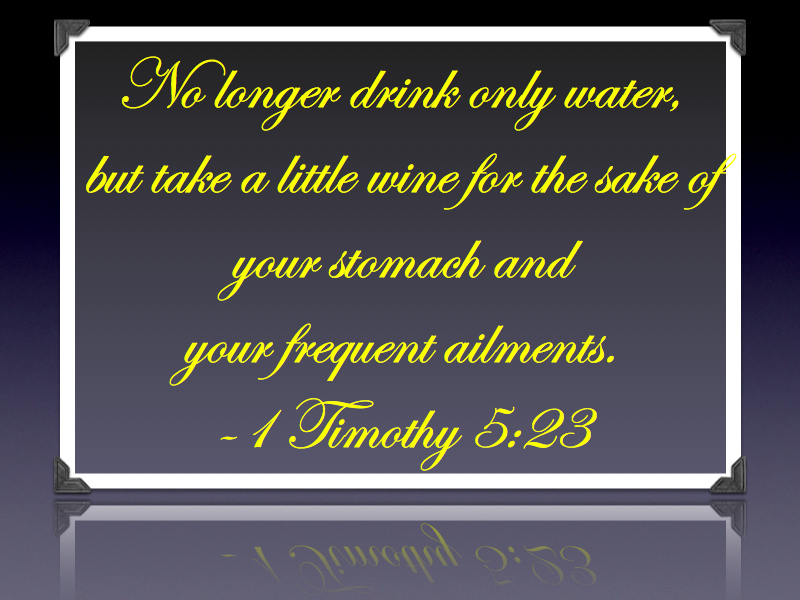
For some time, I've entertained myself with thoughts of making a collection of verses from the scripture that are legitimately in the Bible, but nonetheless would never be engraved on a plaque for sale in a Christian bookstore.

And I begin with a classic:

My complete list (so far) of Christian plaques we'll never find at a Christian bookstore:

  1. 1 Timothy 5:23
  2. No offense to my beloved family, I’m just quoting the words of our Lord… Luke 14:12
  3. This one has made me scratch my head for years. Surely there’s some good explanation about what the Greek word originally meant, etc.: Luke 16:9
  4. For some reason, Jesus’ teachings that have to do with things like sparrows, lillies, and trees have remained more popular than this one: Luke 17:37
  5. This plaque would come with a free framed photo as a gift: Proverbs 11:22
  6. This one might actually sell pretty well: Proverbs 21:9
  7. I‘m including this one minus the usual sarcasm. Your church’s next evangelism campaign may be much healthier if everyone dwells on this for a while: Matthew 23:15
  8. I could also include this passage in a series called, “Scripture passages I’m thankful I’ve never been required to memorize.": 1 Chronicles 2:25-27
  9. Perhaps if Christian bookstore did carry this plaque, it would be packaged together with a new CD titled something like:“The Best of the Mega-SuperStars of Worship, Volume XIX": Isaiah 29:13
  10. Here’s an approach for accountability groups who take their role very seriously: Deuteronomy 13:6-9
  11. These plaques would come in a set of two. And perhaps a more accurate title for them would be “Scripture Plaques You Won’t Find at the [Protestant] Christian Bookstore.”: Romans 2:13 and James 2:24
  12. This is good news for many of us, particularly during football season: Psalm 149:5
  13. Joshua 24:15 makes such a popular plaque ("As for me and my house, we will serve the Lord"), that perhaps we could also include verse 19 in a longer plaque: Joshua 24:15,19.
  14. These are actually very important: Psalm 22:1, Matthew 27:46, Mark 15:34.
  15. Everybody quotes Leviticus 19:18, even Jesus: "love your neighbor as yourself." But what about Leviticus 19:19? Better check your closet!
  16. Moses is certainly a hero of the Scriptures, and is described as someone who spoke to God face to face, as a man speaks with his friend. Well, I've never had a friend say this to me, face to face or otherwise: Numbers 11:19.
  17. If you think your favorite approach to baptism is thoroughly biblical, please let me know what you do with this: 1 Corinthians 15:29.
  18. Need an excuse to launch a line of high-end luxury products for Christian women? Look no further than Jesus' own words: Luke 12:33.
  19. I do happen to be a member of my state's cattle raiser's association, and I believe I've just found our divine endorsement: Romans 14:2.

Pecan Orchards and Holiness

[This is one of the posts telling a story from the life of my Dad. Click here to see the others.]

My Dad has poured the majority of his adult life's work into his pecan orchard. It's a great place. 53 acres of land and about 2,600 trees in an area where we don't see much water or enjoy many trees is remarkable. More remarkable, though, is how peaceful it is there. It isn't very often in the kind of lives most of us lead that we get to be somewhere where it's quiet enough that we cannot hear the sound of any car, machine, or other person, but it's like that in the orchard. Often the only sound you'll hear is the breeze blowing in the trees. We had some friends in the orchard with us on Saturday, and we all noticed the lack of the sounds we were accustomed to and the presence of more natural ones. One of them said the breeze sounded like God was breathing on us. I'd never thought of it like that, but it's certainly a place where I've been aware of God's presence, so his description fits.

As we were there last weekend, I thought about how similar that orchard is to our lives in God, particularly in understanding God's role and our roles in our growth. There are plenty of things in nature that God has accomplished on his own, but that orchard isn't one of them; my Dad has put nearly 40 years of constant work into it. It would not have just popped up without him. Yet regardless of how much effort he put in, neither could my Dad make those trees grow. All that he has ever been able to do is to put into place the conditions in which growth will occur naturally. The planting, watering, pruning, and harvesting have all required his effort, but all of them together cannot produce a single pecan tree. My Dad has put in plenty of effort throughout the process, doing his part, in order to give nature the opportunity to do hers.

In her book, Sacred Rhythms, Ruth Haley Barton describes the same characteristic of the spiritual life: “In the end, this is the most hopeful thing any of us can say about spiritual transformation: I cannot transform myself, or anyone else for that matter. What I can do is create the conditions in which spiritual transformation can take place, by developing and maintaining a rhythm of spiritual practices that keep me open and available to God.”

That is what we do as Christians, "create the conditions... that keep us open and available to God." In fact, it is all that we do. It can, and will, take a lifetime of effort on our part, yet in what seems like a paradox, it requires much effort and yet we are utterly powerless to make ourselves grow in any measure. We cannot force any more love, joy, or peace into our lives. Thankfully, though, just as there are natural processes in place in nature that have allowed 53 acres of pecan trees to grow in this "dry and thirsty land," God's grace is dependably available to work in us when we arrange our lives accordingly. We have to put in effort throughout the process, doing our part, in order to give God the opportunity to do his.

"...work out your own salvation with fear and trembling, for it is God who is at work in you..." (Philippians 2:12-13)

A Parable of Churchville

[This is one of a series of posts related to the REVEAL Spiritual Life Survey. To see the others, click here.] Welcome to Churchville, Population 10. (Generally very good and likeable people.)

An exciting opportunity has come to Churchville, as electricity has become available to the residents.

Time passes, and a very interesting thing happens. Half of the residents of Churchville take advantage of the availability of electricity by bringing it into their homes. One of these comes to believe so strongly in the benefits of electricity that he (upper left) is willing to give anything for the sake of electricity and deeply desires for all of his neighbors to come to experience it as he has. The four others who have connected to electricity are also enthusiastic about it. It has dramatically changed how they live their everyday lives. This "connected" half of Churchville's population all exhibit a love of electricity and a high degree of hospitality toward and concern for their neighbors.

But half of our residents of Churchville have never chosen to connect their homes to the available electric current, and they have varying reasons. One of them simply isn't convinced that electricity exists. He says that his neighbors who claim to have electricity in their homes are just fooling themselves with wishful thinking. Yet, even though he thinks these five neighbors of his are living under a delusion, he remains in Churchville rather than leaving, because it's a good place to be.

The other four of our non-electric residents are a bit more of a puzzle. They believe in electricity, but for whatever reason still have yet to make the appropriate arrangements for it to come into their home. The most notable thing, though, was three of these four seem to be unaware that they are living without electricity! They talk and often act as if they have it in their homes, even to the point of occasionally buying an appliance or sending the electric company money for the bill they think they owe. (One of them even volunteers to serve on the board of the electric company.) Yet these three continue to go on with their electricity-less lives, with no realization that they could be living any differently.

Only one of the non-electric residents notices the gap between how she is living and what her life would be like with electricity. One of the "connected" neighbors gave her a light bulb, and she really wants more light in her house. Neighbors and electric company workers are confident that she will make the necessary arrangements and become connected soon.

So what's the point of the parable? I am a big fan of the REVEAL Spiritual Life Survey for churches. It seeks to give church leaders a measurable way of looking at how effectively they help people grow. Our church participated almost two years ago, and will take our second survey this fall to see how we have improved.

Our results indicate that somewhere close to 1/2 of our people have yet to significantly arrange their lives in ways that would make growth in their love for God and others natural. Also, of these, only about 1 in 5 recognize that things should be different.

Of all of the things that are presented to church leaders as worthy of our time and energy, nothing is more essential than this: modeling and communicating how profoundly good it is to live our lives fully in the kingdom of God, so that any others who desire to do so will know how, and that others will have a more accurate understanding of what it is they're being invited to in the Christian life.

"Jesus went into Galilee, proclaiming the good news: 'It's time. The kingdom of God is now available. Change your mind and direction and believe the good news." (Mark 1:15, paraphrase)

Congratulations, Elmer!/¡Felicitaciones Elmer!

Among the friends I am privileged to have in Guatemala is a man I particularly enjoyed spending time with while we lived there, Elmer. Elmer is on staff at New Life Children's Home, where we were very thankful to have the opportunity to serve for two years. His job description there is hard to define: he is one of the workers who can drive, so he spends a lot of time fighting traffic in Guatemala City running errands for the home and also helps with maintenance and construction projects. More than those things, though, he is a mentor to many of the boys who live at NLCH.

Elmer and I got along well because I'm not sure which of the two of us is more laid back. (I might have thought we were related if he weren't a foot and a half shorter than me.) I enjoyed life at the Guatemalan pace, and (other than the speed at which he drives) he exemplifies it. I remember riding with him on some errands in the city one day, when in the small Ford Ranger-type pickup he was driving, we drove over a huge, deep pothole (more like a sinkhole) in the middle of the street. Because of the traffic, we couldn't see it until it was right in front of us, and our truck had to have just barely been wide enough to clear it. My eyes got huge, and I looked at Elmer, who had no reaction whatsoever. Didn't say a word. After my heart resumed beating, I asked, "Did you see that?!?" In his normal voice, without ever looking back at the street or at me, he said, "Sí... Muy peligroso/Yep... Pretty Dangerous."
Elmer and his family live in similar conditions to many Guatemalans. I don't know what his salary is, but an average Guatemalan lives on something around $2/day. Yet he's very content. He told me "Sometimes guys try to tell me that I should go work with them, doing this or that and make more money. But I have what I need. My family has a place to live and my kids are fed. Everything else is in God's hands."
As Elmer and I got to know each other, I discovered a love for learning in him, which furthered our friendship. As a boy, he attended school through the third grade, then his father told him, "now that you can read and do math, it's time to go to work," and his schooling was over. As the older boys at NLCH would occasionally complain about having to go to school and complete their studies, Elmer was always quick to remind them how privileged they were to have the opportunity, and would talk to them about the possibilities that education could open for them.
He particularly wanted to study the Bible. Not long before we moved back from Guatemala, I learned that he was one of the leaders in his church. He told me that he had heard of courses being offered for those who wanted to become ministers and he really wanted to participate but hadn't been able to yet.
This past June, we returned to visit NLCH for the first time in the two years since we left. I was thrilled to find out that Elmer's church had been offering ministry classes and that he'd been able to participate. He invited us over for dinner one evening, and we had a great time with his family. His boys were all dressed up for our visit (see photo below) and his wife had a good meal of taquitos, fried plantains and coffee ready for us. Elmer proudly showed me his study materials. It was obvious he had been working hard, because the courses were pretty in-depth: New Testament, Old Testament, Church History, and some good material on ministry skills. One section of his material dealt with "success in ministry," and we had a good conversation about that. I told him I'd recently read an article by Dallas Willard with the best definition I'd heard: success for a pastor is having a vital relationship with God and the capacity to pass it on to others. That's important (and difficult) for any pastor to hang on to, regardless of which culture we're in.
Elmer's graduation from his ministry courses was Sunday, August 22. I wish I could have been there to see it, but look forward to celebrating with him the next time we visit.

Elmer, yo quería traducir esto en español también, pero ya es tarde y mi cabeza no me sirve. Te lo prometo que todo lo que dice es amable, ¡y no tenía que mentir! Que sepas que celebramos contigo. Que los estudios que has cumplido te sirven para seguir ayudando a otros conocer mejor al Señor, igual como me has ayudado a mí. Que nosotros dos siempre recuerdan que el éxito para un pastor es tener una relación viviente con Dios y la capacidad de pasarla a los demás, y también recordar que nuestros ministerios primarios siempre son nuestras esposas e hijos. Cualquiera cosa más de esto no es central. Hasta que nos vemos, mi hermano, que la gracia y paz de Jesucristo sean tuyos en abundancia.