
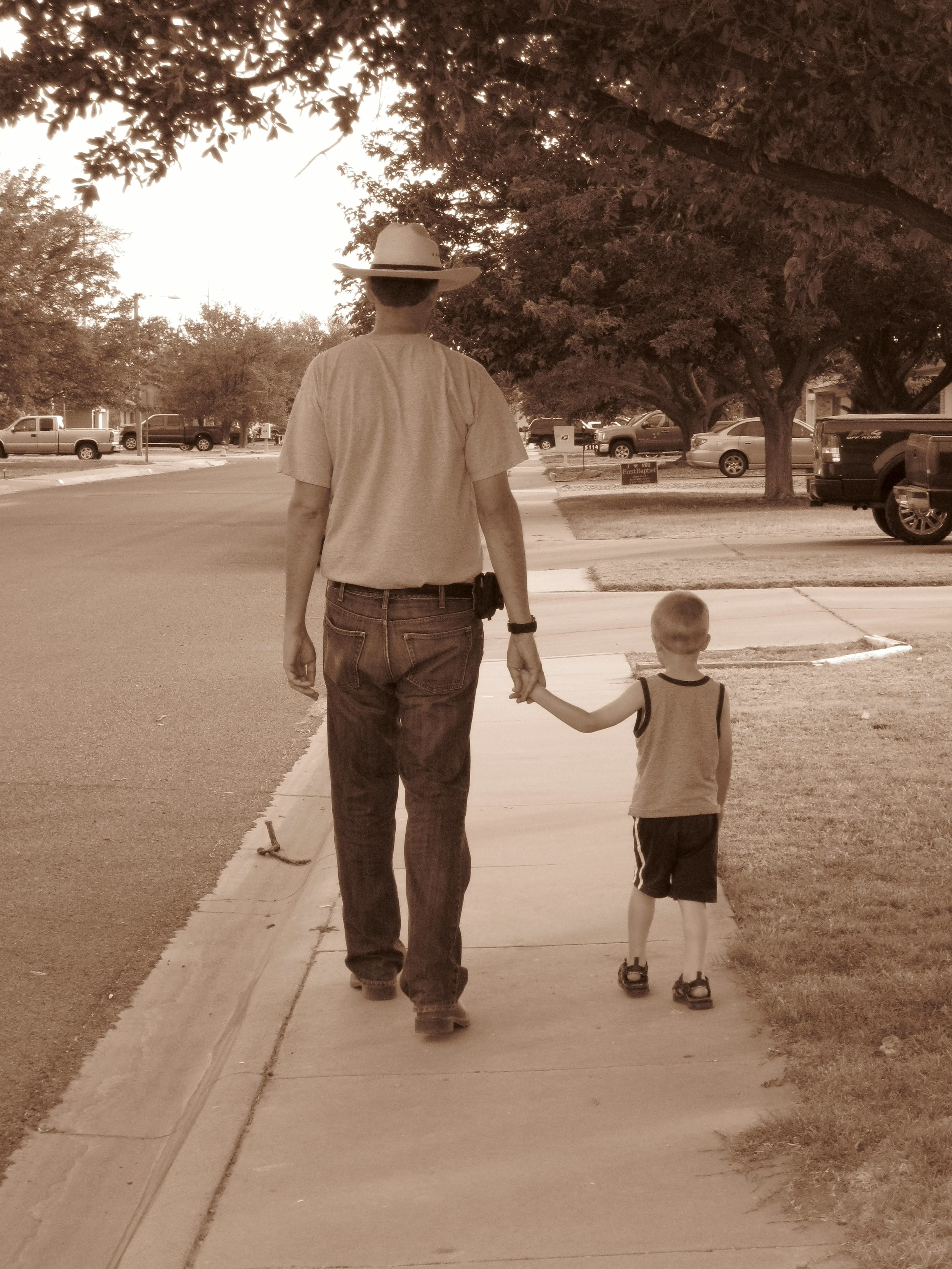
Completely Unhelpful Thoughts I've Shared With My Son

A few days ago, I was tucking my two year old son into bed, and he started begging me to lay on his floor as he fell asleep. I've done that at times in the past, particularly if he doesn't feel good, but we generally like for him to go to sleep by himself.

As I looked at his face and tried to think of the best response to, "But Daddy, I really need you to lay down on my floor for a little while," I thought that I had a moment of fatherhood brilliance.

The idea came to mind to use the moment to teach a profound spiritual truth to my toddler about God's presence with us. He has a book we read together at night that has a line where a person smiles and whispers, "God is here." So I thought to myself, "That's it! I'll teach him that God is in the room with him, and then it will let me off the hook about having to lay on his floor." The conversation went something like this.

Little D: But Daddy, I really need you to lay down on my floor for a while.

Me: Hey, Bud, you know that part in your book where someone smiles and whispers, "God is here"?

Little D: Yeah.

Me: Well, it's like that. I can't stay in your room right now, but God is here with you. So if you're laying here in your bed, you can look over there and imagine that God is laying on your floor while you fall asleep.

Little D:

Me: Does that help a little bit?

Little D, without any moment of hesitation: No.

He made it very clear that he wasn't willing to accept theology in exchange for my presence in the room (even though I still think my theology was good). As soon as he did so, I knew what I had done was a bit silly; two year olds need their dads to be there in front of their eyes and live out what God is like, much more than they need us to use words to try to explain to them that an invisible God is always near. There are things about this that are both troubling and relieving to me.

Why it troubles me: I feel like I'm pretty good at explaining theology to people, but living it out in front of the always-learning eyes of a pre-schooler is a different ballgame. I enjoy talking about theology, I've got a really good sermon in my file about God's presence with us, and talking about these things with people is even part of what I get paid to do. But those things didn't do my little boy one ounce of good the other night.

What he told me with his quick "No" was that he needs a daddy whose character is so much like that of Jesus that it will make the theology lessons come easier later on. He needs me to be the kind of person who, by seeing me every day, will help him when he gets older and starts to think for himself about what we mean when we say that God is here, or is loving, good, forgiving, trustworthy, or holy... that those things will be very naturally believable to him because of how he has seen them in the life of his Daddy right before his eyes.

That sounds good as a write it, but it's a very tall order when I'm crabby, just wanting people to go along with my own plans so that I can accomplish the things I want to, and certainly not feeling much like that kind of Daddy that he needs. There are plenty of times that I would prefer trying to explain sanctification to a two year old than give him living proof of it.

But here's why it relieves me: because that Daddy that he wants and needs, who shows him what God's character is like and passes it on to him, is not only who he needs but is also who I most want to be. If I work at answering the question, deep-down at my gut level, of what I want most in life... that's it. I want to be that kind of man for my family. So I'm relieved that I don't have to come up with a children's book that would effectively help my kids understand atonement theories or the widely different views on eschatology, but instead that my main task is to shape my life in a way that I will predictably become more and more who they need me to be.

It's still a rare night that I lay down on his floor while he falls asleep, but I'm glad he gave me the reminder that my theology degrees are really not helpful to him, unless he can see with his eyes what they mean as he watches me.

So I guess I'll give up on that idea of reading Wesley's sermons to him for bedtime stories...

Wesley's Sermon 24: Upon Our Lord's Sermon on the Mount, Discourse 4

[This is a post on one of John Wesley's Sermons as part of the Getting to Know John series. See the other posts here.]

"Christianity is essentially a social religion... to turn it into a solitary one is to destroy it."

This is the fourth of Wesley’s thirteen sermons on Jesus’ Sermon on the Mount (Matthew chapters 5, 6, and 7). This sermon focuses on Matthew 5:13-16: "You are the salt of the earth... You are the light of the world... A city on a hill cannot be hidden... Let your light shine before others..."

Wesley says some brilliant stuff in this sermon. Much of it is a counter-argument against a movement in his day called "quietism," which taught that Christians only needed to worship God inwardly so as to avoid trusting too much in anything outward. Wesley never denies the importance of the inner aspects of our faith; in fact, he encourages ample time alone with God (at least two periods of solitude every day!). But he says that the inward roots have to produce outward branches in our lives with others, or else we cannot fulfill the kind of life that Jesus describes in the Sermon on the Mount.

Wesley begins this sermon by explaining the quotation above, that Christianity is essentially a social religion and to turn it into a solitary one is to destroy it. What he means by Christianity being a "social religion" is that it does not survive at all without "society" (which he describes as living and conversing with others; today we would be more likely to use the word "community"). He then describes the absurdity (also described by Jesus) of thinking that the light God has put into our souls can or should be hidden. Then he concludes the sermon by answering foreseen objections from critics.

Wesley is a master at holding together things which seem to be opposites, and finding a place of tremendous strength in hanging on to them both. This sermon is a great example of how he does this, in this case with "inward religion" and "outward religion." Christians of all groups would do well to dig into what he says here.

For further exploration of this sermon:

A Prayer for the Thirteenth Sunday of Ordinary Time (Year A)

[This is one of a series of Prayers for the Christian Year. To see the other posts, click here.] Living, loving Father,

Sometimes it seems like You have forgotten us, Your own children. We look, but cannot see Your face. We have pain in our souls, sorrow in our hearts, and it seems as if we are being destroyed while You stand by.

Yet experience has taught us that Your timing is different, and much better, than our own. Even when it seems that we are about to lose everything that gives our lives meaning, we have seen You intervene just in time. You do not act too early, nor do You act too late, and in the end Your love always has always proven to be unfailing.

We have come to know that the road of obeying You, following along in Your ways, often does not feel easy. We may be asked to follow You up some difficult mountains. This was asked of Your friend Abraham, and has been asked of many of Your friends through the centuries, including Your own Son, our Savior, Jesus Christ.

So give us strength when following You is not easy, by helping us to remember that even at the worst conceivable moments, Abraham trusted Your love, Jesus trusted Your love, and we are invited to do the same.

We know that we are not alone on this path, but that many others have walked it before us, and many walk it alongside us now.

As we walk where You lead us, following the example of Jesus, we are taught how to speak to others with our mouths like He would , how to serve and give cups of cold water with our hands like He would, how to follow Him with our feet farther along in Your ways. As we do so, we realize that our bodies and our whole beings become more and more able to do the things that You want and less and less inclined to separate ourselves from You.

So continue to lead us along in the ways of Your Son. Although we do not know where You are taking us, we know that You have dealt always bountifully with us, and You will continue to do so forever.

As we we continue along this way as Jesus' students, again today we take the step of praying the prayer that He taught us, saying,

Our Father in heaven, hallowed be Your name, Your kingdom come, Your will be done, on earth as in heaven.

Give us today our daily bread.

Forgive us our sins as we forgive those who sin against us.

Save us from the time of trial and deliver us from evil.

For the kingdom, the power, and the glory are Yours now and for ever. Amen

Notes:

This week, the readings shift from being aligned with one another to being aligned over a series of weeks. In other words, during the seasons of the Christian year of Advent, Christmas, Lent, and Easter, the four readings for each week have a connection to one another, something like this:

However, as of this week, we are full-swing into "Ordinary Time." We don't call it ordinary in the sense of being plain or boring, but in the sense of being sequenced. So, instead of a particular reading relating to the other readings in that same week, most often during Ordinary Time, a particular reading will be part of a sequence, like this:

Depending on which system of ordering one pays attention to, this Sunday can also be referred to as Proper 8, or (in 2011) the Second Sunday after Pentecost. Regardless of the system, the readings are the same. So, the readings for this week, on which this prayer is based, are:

  • Genesis 22:1-14: The sixth of thirteen possible consecutive readings after Pentecost from Genesis, and the fourth of five on the life of Abraham. This passage recounts God's testing of Abraham, when he asked him to sacrifice his son Isaac. When God saw that Abraham would obey, he intervened and provided a ram to be the sacrifice in Isaac's place. It's striking that God did not tell Abraham about the fuller plan as soon as he'd made up his mind to obey, but Abraham went through every possible step in obedience short of actually taking his son's life. God intervened at the last possible moment. God provides, but often not until we're up on that mountain.
  • Psalm 13: A psalm of lament (or complaint) by David, pleading for God to deliver him from his enemies. As is common, the psalm ends with a steadfast commitment to trust in God, who despite the current appearances, has always proven himself faithful.
  • Romans 6:12-23: The fifth of sixteen possible consecutive readings after Pentecost from Romans. In this passage, Paul encourages his readers train their bodies to live into their identity as servants of righteousness, rather than submitting themselves to further domination by sin.
  • Matthew 10:40-42: All of the gospel readings after Pentecost in Year A come from Matthew, and this is the third of three possible readings on Jesus' commissioning of the twelve apostles to go and minister to others. In this week's reading, Jesus teaches his students that as people treat them (and, therefore, as we treat others), it is as if the same treatment is being given directly to him.

The Biggest Hurdle to Great Ministry

I have more confidence in one book on Christian leadership than any other that I've read, and that book is Strengthening the Soul of Your Leadership by Ruth Haley Barton. (Click to find out more about Ruth's ministry, The Transforming Center.) Each time that I revisit one of its chapters, something new sticks with me, but the powerful premise on which Ruth bases the entire book is this: "Truly, the best thing any of us have to bring to leadership is our own transforming selves" (page 19).

Upon first glance, it may not seem like all that radical of a statement, but if we let ourselves be put to its test, it won't take long to find some of the many ways in which we don't really believe it. Particularly in ministry leadership, it implies:

  • my own process of becoming more like Christ is more important than any skills I bring to the table, which means
  • my ability to love others well is more important than my ability lead them, which means
  • the degree to which Jesus' life in me is so abundant that it will naturally influence those around me is more important than my ability to manage them, to preach a moving sermon to them, or set meaningful goals and objectives for them, which means
  • although it's great for me to develop all of these skills and others, to do so without giving ample time, space, and attention to the things that lead to my transformation to become more like Jesus is to miss the point.

Not only have I been tremendously challenged by this statement from Ruth, but I've been equally challenged by its natural corollary. If our own transforming selves are the most important thing to move us forward in leadership as Christians, we can carry the statement another step forward and identify the biggest hurdle to great Christian leadership:

my own unlikeness to Jesus.

The implications of this won't feel fun to deal with, but can certainly lead us into a much better way of living and leading for others:

  • the primary hurdle to Jesus' kind of life growing in those whom we influence is never "out there," but "right here," which means
  • the answer is never really to be found by finding a different church, a different boss, a different pastor, a different small group, a different curriculum, or any other difference that leaves me unchanged, which means
  • if I have any desire for my community to be led well, I should immediately stop blaming anyone else for it not being so. Instead, I need to take the huge responsibility of un-busying myself enough to make room for the hard work of the things which reliably lead to transformation like prayer, solitude, silence, and serving others in secret.

In other words, the biggest hurdle to great ministry in my community is never someone or something else, but my own lack of love, joy, peace, and all of the other things that Jesus' kind of life naturally produces in me. In the short term, it's much easier just to blame someone else rather than deal with these kinds of things, but we've all tried that course for a while, and, honestly, how helpful has that turned out to be?

A Great Father's Day Card from My Favorite Boy

I got a great Father's Day card from my 2-year-old boy today. It was hand-made, with excellent sticker selection and placement. (The front is pictured above, and the back is covered with Diego stickers.) The inside of the card is my favorite, though, because it has his answers to questions about me.

  • What is Daddy's full name? Daniel Daddy.
  • What color is Daddy's hair? Black.
  • What color are Daddy's eyes? Brown.
  • How old is Daddy? 4.
  • How tall is Daddy? Tall like me.
  • What do you like to do with Daddy? Play Ring the Gack, watch the triangle while it's on.
  • What is Daddy's favorite sports team? Me.
  • What else do you like to do with Daddy? Do my shaving cream.
  • What do you want to say to Daddy on Father's Day? I love you, Daniel. You like to play Ring the Gack with me, Daniel.

The first thought that comes to my mind as I look at this card again is that I love being Daniel Daddy. We all have words attached to us in our different roles in life to describe what we do, and among the roles I have in life, there are none that come close to bringing me the enjoyment as much as those I have here in my own house. I love being a daddy.

So, who's up for a round of Ring the Gack?

Wesley's Sermon 23: Upon Our Lord's Sermon on the Mount, Discourse 3

[This is a post on one of John Wesley's Sermons as part of the Getting to Know John series. See the other posts here.] This is the third of Wesley’s thirteen sermons on Jesus’ Sermon on the Mount (Matthew chapters 5, 6, and 7). In this sermon, he continues working his way through the Beatitudes and focuses on Matthew 5:8-12: “Blessed are the pure in heart… Blessed are peacemakers… Blessed are those who are persecuted for righteousness' sake…”

Also, as in the previous sermon, Wesley believed that Jesus used the remainder of chapter 5 to provide illustrations of the life he describes in these verses. So to further explore the meaning of Matthew 5:8-12, Wesley also explores Matthew 5:33-48.

Wesley continues his approach to the Beatitudes as both being characteristics that are in some degree true of all of God's children all of the time, and also a process that we go through as we mature spiritually. This sermon begins right where the last one left off, describing those who have learned to love their neighbors as themselves. To begin this sermon he says we must examine the foundation of that love, and explores the meaning of "Blessed are the pure in heart..."

He explains that purity of heart is emphasized by Jesus throughout his teaching, rather than only outward acts. He also provides an interesting explanation of how it is that the pure in heart "see God," saying that by faith we will see him through our deep fellowship with him, his presence in our world, his provision of our needs, and most fully through his ordinances (prayer, searching the Scriptures, the Lord's Supper, etc.). He then uses Matthew 5:33-37 as an illustration of those who are not pure in heart and felt the need to depend on oaths versus those who are pure in heart and could let their speech be trusted and had a deep sense of God's presence everywhere (heaven is God's throne and earth is God's footstool).

According to Wesley, with "Blessed are the Peacemakers..." Jesus' teaching shifts from what we kind of people we are to be to focusing on what kinds of things we should do and say. He says that peacemakers are not only those who work to end and avoid strife and conflict, but in a more general sense, they are those who do good to others at every opportunity they are given by meeting physical needs, and when the opportunities arise, spiritual needs as well.

He then moves into an examination of Jesus' statements on persecution, stating that although we would hope and think that people who live lives such as he has described to this point in the Beatitudes would be well loved by everyone, that is certainly not the case. The world's ways will always be violently opposed to the ways of God, and this results in persecution of the righteous. Wesley describes different forms that persecution can take, some major (such as losing our lives), and others more minor (such as losing relationships), but he says that regardless of whatever kind of persecution we face, it should never cause us to lose our meekness, love, and kindness toward others.

Again turning to another passage of Matthew 5 to illustrate, Wesley uses Jesus' statements on turning the other cheek, refusing to return evil for evil but rather returning good for evil, and then gives a very valuable paragraph on some practical ways to think about this. Much harm has been done by those who have taken Jesus' statement to mean things that he never said here, and Wesley provides a valuable corrective, which applies to in broader senses in this context beyond just material possessions:

Although Jesus said that we should always be ready to give to whomever asks of us without expecting anything in return, he never said that we should give things that do not belong to us. Wesley explains with three short points:

  • We need to take much care to avoid all kinds of debt. If we give to others while we have debts, we are actually giving someone else's things away, not our own. (For our day, Dave Ramsey offers great advice. We should give while we are working to get out of debt, but set a limit on the giving during that time, such as 10%. In other words, if you're making your tithe to your church on your credit card and running your debt up higher, stop it. Still tithe, but on money you actually have.)In another sense which Wesley doesn't mention here, Jesus does offer the illustration of offering our other cheek to someone who hits us. He never says that we should offer the cheeks of other people to be injured.
  • We should provide for our own household the things that are necessary to sustain them in life and godliness. If we give to such a point that we cannot do this, it is certainly not being done in the spirit of Jesus' teaching.
  • Then, we should give away everything that's left over. (Certainly there are wise ways to do this, so that we're actually helping the recipients rather than harming them.) He says if we don't have enough to give to everyone, we should begin by remembering the "household of faith," then give to others as we are able.

Wesley finishes with a concluding paragraph about the Beatitudes, calling them "a picture drawn by God's own hand" of the life intended for us. His interpretation of the Beatitudes is valuable and inspiring. (As I've mentioned before, I've come to view the Beatitudes in a different way, thanks to Dallas Willard. I'll post a summary of Wesley's understanding compared to Willard's soon.)

If you would like to dig in further to this sermon:

A Prayer for Trinity Sunday (Year A)

[This is one of a series of Prayers for the Christian Year. To see the other posts, click here.]

Living, loving Father,

Your name is majestic in all the earth. When we look around us, we are amazed that You, who have such magnificent power that You can create by speaking, still care for us so much.

From before the beginning of time until now, You have been alive and loving. By Your Word and Your Spirit, You created us and our world. You said, "Let us make humankind in our image, according to our likeness," which culminated Your work of creation, which You saw as very good.

Later, the Word by which You created came and lived a marvelous life among us, He died a horrible death because of our sin, He rose again to life, conquering death and sin, and then ascended to reign with You.

It was He who assured us that it would be better for us if He went away, because then Your Spirit could come and give all of us the chance to live in fellowship with You.

You have given Him authority over everything, so enable us to go to every group of people in our world, and help them to become His apprentices as we are, being immersed in the reality of a world pervaded by You, Your Spirit, and Your beloved Son, Jesus Christ, our Lord.

May His abundant grace, Your unfailing love, and Your Spirit's enlivening communion be with each of us and all of Your children, as we continue to pray the prayer that Jesus, our Savior and Master, taught us, saying,

Our Father in heaven, hallowed be Your name, Your kingdom come, Your will be done, on earth as in heaven.

Give us today our daily bread.

Forgive us our sins as we forgive those who sin against us.

Save us from the time of trial and deliver us from evil.

For the kingdom, the power, and the glory are Yours now and for ever. Amen

Notes:

This Sunday, the first Sunday after Pentecost, is Trinity Sunday. Having now remembered Jesus' suffering, death, resurrection and ascension, and the coming of the Holy Spirit in power at Pentecost, during this week each year, we consider God's nature as three-in-one before moving into Ordinary Time until Advent begins. The readings for this week, on which this prayer is based, are:

  • Genesis 1:1-2:4a: The Genesis account of God's creation of the heavens, earth, plant and animal life, and humanity. This reading is included on Trinity Sunday because of hints of each member of the Trinity's activity in creation. God the Father sees things, speaks things, says "let us create humankind in our image, and when creation was finished, called it very good. God the Son's activity is intimated by the Father's speaking, since Christ is described later as the Word who was with God, was God, without whom nothing was made, and who became flesh and dwelt among us. God the Spirit was active in creation even before light and darkness came about, as "the Spirit of God was moving over the face of the waters."
  • Psalm 8: David echoes the Genesis creation story and celebrates God's presence and power in the world, marveling at the things created in the world and the place among all of them that has been given to humanity. (This is also the psalm for Trinity Sunday in Year C).
  • 2 Corinthians 13:11-13: Paul's concluding greetings in this letter to the Corinthians, which includes his prayer of blessing for them in the Trinity, which has come to be known as the Apostolic blessing.
  • Matthew 28:16-20: Jesus' "great commission" to his disciples after his resurrection, when he charged his followers to make disciples of all nations, baptize them in the name of the Trinity, teach them to obey everything he commanded, and promised that he would always be with them.